
A work truck isn’t just transportation. It’s how you make a living. The right one pays for itself. The wrong one costs you time and money you didn’t budget for. This guide is built for Emerald Coast business owners who need a used vehicle that earns its keep: from choosing the right truck, van, or SUV, to claiming every dollar in Section 179 tax deductions, to knowing what to look for before you buy.
What’s In This Guide
- Used business vehicle buying checklist
- Types of business vehicles and what they’re best for
- Section 179 tax deduction (2026 rules)
- Business vs. personal vehicle purchase
- Insurance: Commercial vs. personal
- Financing a business vehicle
- What to look for in a used work vehicle
- Common mistakes to avoid
- Emerald Coast business needs by industry
Used Business Vehicle Buying Checklist
Get these done before you shop
Having a plan before you shop makes the whole process faster and more productive. You’ll know exactly what you need, what fits your budget, and what to look for.
Take care of these items before you shop. You’ll make decisions from confidence instead of guesswork.
Types of Business Vehicles
Matching the vehicle to your operation
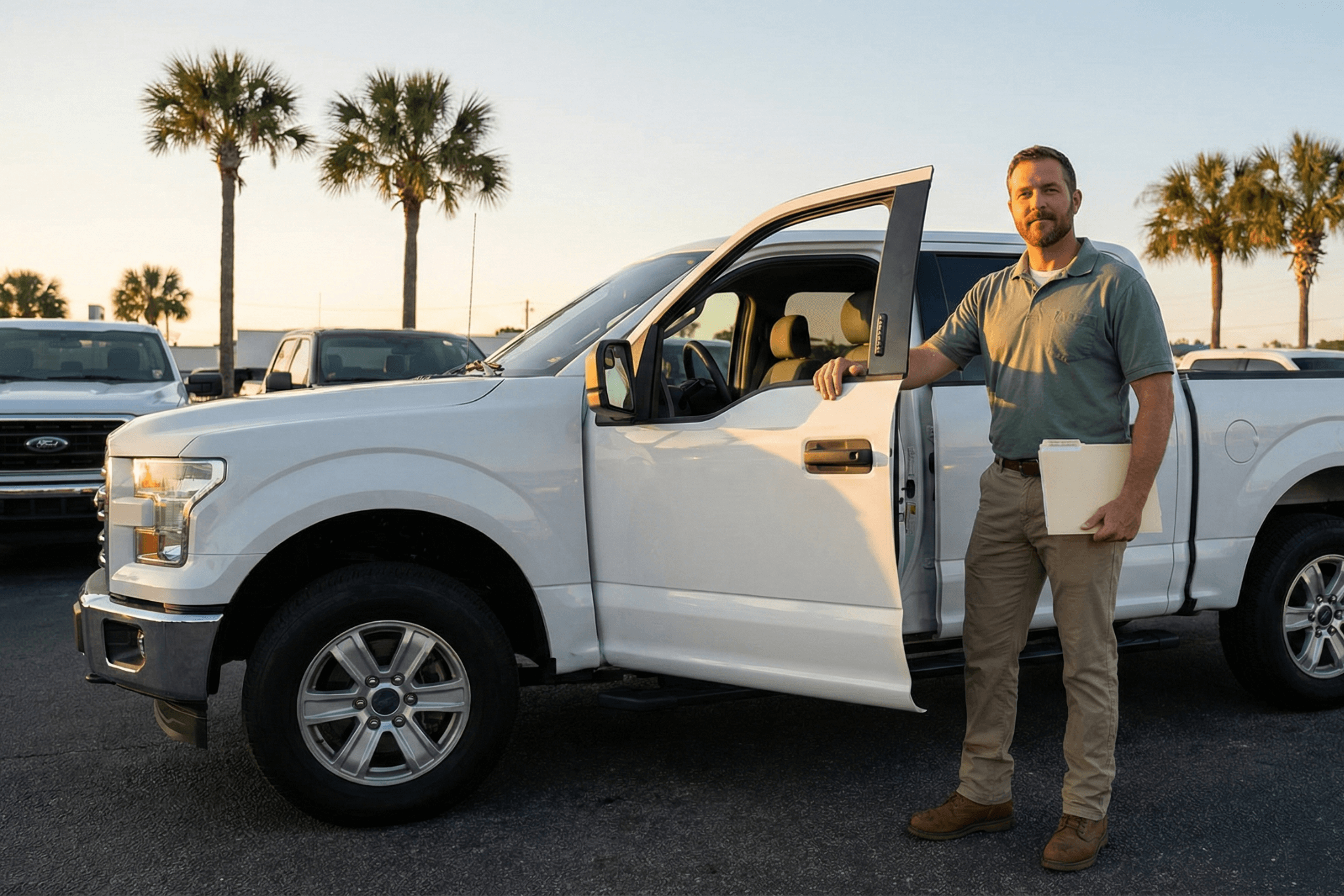
Not every business needs a one-ton dually. And not every business can get by with a compact SUV.
The key is matching capability to your actual workload, with a little headroom for growth. A fishing charter captain pulling a 24-foot bay boat has completely different needs than an electrician running service calls. Here’s how the main categories stack up.
Pickup Trucks
There’s a reason pickups dominate job sites from coast to coast. They haul, they tow, and they’re built to take punishment. For most trades (construction, landscaping, agriculture, marine services), a truck is the natural choice.
- Half-ton (1500 series). Ford F-150, Chevy Silverado 1500, RAM 1500. Good for lighter loads and daily driving. Most configurations have GVWR over 6,000 lbs (F-150 ranges from 6,100-7,850 lbs depending on configuration). Check the door jamb sticker for exact GVWR.
- Three-quarter ton (2500 series). F-250, Silverado 2500, RAM 2500. Heavier payloads, better towing. Usually over 6,000 lbs GVWR, which is better for Section 179.
- One-ton (3500 series). F-350, Silverado 3500, RAM 3500. Maximum capability for serious work. Often over 10,000 lbs GVWR.
Weight matters for taxes: Vehicles over 6,000 lbs GVWR qualify for higher Section 179 deductions. Most half-ton, three-quarter ton, and one-ton trucks, plus full-size SUVs, meet this threshold. Always check the door jamb sticker for the exact GVWR.
Cargo Vans
If your work involves tools, parts, and equipment that need to stay organized, dry, and secure, a cargo van earns its keep fast.
Plumbers, electricians, and HVAC contractors love them for good reason. You can build out the interior exactly how you need it. And nobody’s walking off with your $3,000 pipe threader while you’re grabbing lunch.
- Compact cargo vans. Ford Transit Connect, RAM ProMaster City. Easier to park, better fuel economy, limited cargo space.
- Full-size cargo vans. Ford Transit, Mercedes Sprinter, RAM ProMaster. More cargo capacity. Can be upfitted with shelving and equipment.
Passenger Vans
Passenger vans are the workhorses of the people-moving business. If you’re running an airport shuttle out of VPS, a dive tour operation off the Destin jetties, or transporting a construction crew across town, this is the category.
On the Emerald Coast, tour operators and fishing charter companies often need 12-15 passenger configurations. Just be aware that passenger count and commercial use can trigger CDL requirements.
- 12-15 passenger configurations. Ford Transit Passenger, RAM ProMaster Window Van, Mercedes Sprinter Passenger.
- CDL may be required. Vehicles designed for 16+ passengers typically require a CDL. Check Florida DMV requirements for your specific use case.
SUVs for Business
Professional appearance with utility. Best for: real estate, sales, executive transport, mixed personal/business use.
- Mid-size SUVs. Often under 6,000 lbs GVWR, which means limited Section 179 benefits.
- Full-size SUVs. Suburban, Expedition, Yukon XL. Usually over 6,000 lbs GVWR. Subject to the $32,000 Section 179 cap for 2026.

Section 179 Tax Deduction (2026 Rules)
How to write off your work vehicle the year you buy it
Here’s where things get interesting. Section 179 of the IRS tax code lets you deduct the full purchase price of a qualifying work vehicle in the year you buy it. Not spread out over five or seven years of depreciation. All at once.
On a $45,000 truck at a 24% tax bracket, that’s roughly $10,800 back in your pocket at tax time.
The best part? Section 179 doesn’t care whether your truck rolled off the assembly line last month or three years ago. As long as the vehicle is “new to you” (meaning you haven’t used it in your business before) and it meets the weight and usage requirements, you qualify for the same deduction. That’s a real advantage for business owners shopping the used market.
A word of caution: Tax law is complex, and the specifics of your situation matter. This guide provides general information to help you understand the landscape, but always loop in your accountant or tax professional before making purchase decisions based on tax benefits.
2026 Section 179 Limits
| Category | 2026 Limit |
|---|---|
| Maximum Section 179 deduction | $2,560,000 |
| Phase-out threshold | $4,090,000 |
| Heavy SUV cap (6,000-14,000 lbs) | $32,000 |
| Light vehicle limit (under 6,000 lbs) | ~$20,400 first year (2025 figure; 2026 limit pending IRS guidance) |
| Bonus depreciation | 100% (restored for 2026 and beyond) |
Which Vehicles Qualify?
| Vehicle Type | GVWR | Section 179 Treatment |
|---|---|---|
| Work trucks, cargo vans | Over 6,000 lbs | Full deduction possible (up to $2.56M limit) |
| Heavy SUVs | 6,000-14,000 lbs | Capped at $32,000 for Section 179 |
| Light vehicles | Under 6,000 lbs | “Luxury auto” limits apply (~$20,400 first year based on 2025; 2026 limit pending) |
| Specialty vehicles | Over 14,000 lbs | Full deduction possible |
Key Requirements
- Business use over 50%. You must use the vehicle more than half the time for business purposes. Keep mileage logs.
- Placed in service by December 31. The vehicle must be purchased and in use by year-end to claim the deduction for that tax year.
- Taxable income limitation. Your Section 179 deduction cannot exceed your taxable business income.
- Documentation. Keep purchase records, mileage logs, and business use documentation for at least 5 years.
Record Keeping Requirements
The IRS requires “contemporaneous” records for vehicle deductions. That means you must document trips as they happen, not reconstruct them later.
This is especially important because vehicles are considered “listed property” with stricter substantiation rules.
Your mileage log must include:
- Date of each trip
- Starting and ending locations
- Business purpose of the trip (e.g., “met client at job site,” “picked up materials from supplier”)
- Miles driven
- Odometer readings at beginning and end of each year
You can track mileage using a paper log, spreadsheet, or smartphone app. Many business owners find apps easier since they record trips automatically using GPS.
How long to keep records: The IRS recommends keeping vehicle records for at least 3 years after filing your return. However, many tax professionals suggest 5-7 years to cover potential audits and state requirements.
Depreciation Recapture: What Happens When You Sell
When you sell a vehicle on which you claimed Section 179 or bonus depreciation, you may face “depreciation recapture.” This means part of your previous deduction gets added back to your taxable income.
How recapture works:
- Gain up to depreciation taken = ordinary income. If you claimed $45,000 in Section 179 and later sell the vehicle for $25,000, that $25,000 is taxed as ordinary income (not capital gains).
- Reported on IRS Form 4797. Sales of business property, including vehicles.
- Applies regardless of when you sell. Whether you sell 2 years or 10 years later.
Business use drops below 50%: If your business use falls to 50% or below during the vehicle’s recovery period (generally 5 years), the IRS requires you to recalculate depreciation using straight-line method. You must report the difference as ordinary income on your return that year.
Example: A Destin charter captain claimed $50,000 Section 179 on a work truck. Three years later, she sells it for $30,000. That $30,000 is reported as ordinary income (taxed at her regular income tax rate), not as a capital gain.
Alternative: Standard Mileage Rate
If you don’t claim Section 179 on your vehicle, you may be able to use the IRS standard mileage rate instead of tracking actual expenses.
| Year | Standard Mileage Rate (Business) |
|---|---|
| 2026 | 72.5 cents per mile |
| 2025 | 70 cents per mile |
Important restriction: If you claim Section 179 or bonus depreciation on a vehicle, you cannot use the standard mileage rate for that vehicle in later years. You must use the actual expense method for the life of the vehicle.
The standard mileage rate method may work well for lighter vehicles (under 6,000 lbs GVWR) that don’t qualify for full Section 179 deductions, or for employees using personal vehicles for business purposes.
Example: Section 179 in Action
A Fort Walton Beach contractor buys a used Ford F-250 (GVWR over 6,000 lbs) for $45,000. The truck is used 100% for business.
- Section 179 deduction: $45,000 (full purchase price)
- Tax savings at 24% bracket: ~$10,800 in federal tax savings
- State tax savings: Florida has no state income tax, but other states may offer additional savings
This is a simplified example. Actual tax savings depend on your specific situation, tax bracket, and other deductions. Consult your tax professional.

Business vs. Personal Purchase
This decision affects your taxes, your liability, and your financing options
Here’s a question that trips up a lot of first-time business vehicle buyers: should your company buy this truck, or should you?
It’s not just paperwork. This decision affects how you claim deductions, who’s liable if something goes wrong, and how the vehicle shows up on your balance sheet. Neither answer is universally “right.” But it’s worth making the call before you start the buying process.
Buying Through Your Business
When your LLC, corporation, or partnership buys the vehicle directly, it becomes a business asset. That makes expense tracking cleaner and deductions more straightforward. But there are trade-offs.
- Pros: Clear business expense, easier to claim deductions, separates personal and business liability, may build business credit
- Cons: May require business credit history, potentially higher insurance rates, vehicle is a business asset (could be seized if business has debts)
Buying Personally and Using for Business
The alternative: buy the vehicle in your own name and deduct the business-use portion of expenses.
This often works better for newer businesses with limited credit history, or for owners who want to keep the vehicle as a personal asset.
- Pros: Easier financing (personal credit), vehicle is personal asset, can still deduct business use portion
- Cons: Must track business vs. personal mileage carefully, only deduct the business-use percentage, can’t fully separate from personal liability
Ask your accountant: The right choice depends on your business structure, personal vs. business credit, and overall tax strategy. This decision should be made before you buy.
Insurance: Commercial vs. Personal
Why your personal policy probably won’t cut it
Insurance might be the least exciting part of buying a work vehicle. But having the right coverage in place protects everything else you’ve built.
Here’s the uncomfortable truth: that personal auto policy you’ve had for years almost certainly excludes business use. Get into an accident while hauling tools to a job site, and your insurer can deny the claim entirely. Suddenly you’re personally on the hook for damages, medical bills, and legal fees.
When You Need Commercial Auto Insurance
The short answer: probably now.
Commercial coverage is typically required when the vehicle is titled to your business entity (LLC, corporation, partnership). It’s also required when employees other than yourself will drive it, when you’re transporting equipment or passengers for work, or when the vehicle is a heavy-duty truck or specialized work rig. If any of those apply, personal coverage won’t cut it.
Why Personal Auto Policies Fall Short
Personal policies are designed for personal use: commuting, errands, road trips. The moment you start using that vehicle to generate income, you’ve stepped outside the policy’s coverage territory.
Insurers are meticulous about this distinction. Claims adjusters know exactly what questions to ask.
The real risk: A contractor with a personal policy gets rear-ended while hauling materials to a job site. The insurer investigates, determines the vehicle was being used for business, and denies the claim. The contractor is now personally liable for the other driver’s medical bills, vehicle damage, and a potential lawsuit. All because of a coverage gap that would have cost a few hundred dollars more per year to close.
Hired and Non-Owned Auto Insurance (HNOA)
Not every business needs a dedicated fleet vehicle. If you or your employees occasionally use personal cars for business (client meetings, supply runs, site visits), Hired and Non-Owned Auto coverage bridges the gap.
It protects the business when personal vehicles are pressed into service. It’s available as a standalone policy or as an add-on to your general liability coverage.
What Commercial Auto Typically Costs
Commercial auto insurance generally costs more than personal coverage due to higher liability limits and increased risk exposure. Factors that affect your premium include:
- Type of vehicle (pickup truck vs. cargo van vs. heavy-duty truck)
- What you use the vehicle for (delivery, construction, passenger transport)
- Number of drivers covered
- Your claims history and driving records
- Coverage limits you select
Tax deductible: Commercial auto insurance premiums are a deductible business expense. Keep your premium statements and proof of payment for your records.
Financing a Business Vehicle
How to pay for it without draining your cash
Cash is king, but it’s not always practical. Especially when that capital could be working elsewhere in your business.
The good news: you’ve got options. The right financing structure depends less on the vehicle itself than on your business situation, credit profile, and cash flow priorities.
Business Auto Loans
Business auto loans work much like their personal counterparts, except lenders evaluate your company’s financials rather than (or in addition to) your personal credit.
Expect to provide two years of business tax returns, recent bank statements, your EIN, and business license. Many lenders also require a personal guarantee, especially for smaller or newer businesses.
Rates vary based on your business credit score, time in operation, and overall financial health. Newer businesses typically pay a premium. Terms generally run 24 to 72 months.
Personal Financing for Business Use
There’s nothing stopping you from financing a vehicle personally and using it for business. If your personal credit is stronger than your business credit, this route often yields better rates.
The trade-off: you’ll need to meticulously track business versus personal use, since you can only deduct the business-use percentage of your expenses. For some owners, the simpler approval process is worth the extra record-keeping.
The Case for Buying Used
New trucks smell great. They also hemorrhage value the moment you drive off the lot. Somewhere between 20% and 30% in the first year alone. For a business vehicle that’s going to accumulate miles, haul equipment, and earn its keep, that depreciation hit is hard to justify.
A well-chosen used vehicle avoids the steepest part of that depreciation curve while delivering the same Section 179 tax benefits as a brand-new model. Insurance premiums run lower. You’ve got years of real-world reliability data to reference.
And the money you save can go toward equipment, payroll, or that expansion you’ve been planning. For most business buyers, the math favors used.
At Destin Autos: Our finance team works with business owners across the Emerald Coast every week. Whether you’re financing under your business name or personally, we can walk you through the options. Get started with financing →
Florida Sales Tax on Vehicle Purchases
When you buy a vehicle in Florida, you’ll pay sales tax at closing. There are no special exemptions for business vehicle purchases.
| Tax Type | Rate | Notes |
|---|---|---|
| Florida state sales tax | 6% | Applies to full purchase price |
| Okaloosa County surtax | 1% | Applies only to first $5,000 of purchase price |
| Total (Okaloosa County) | ~6.1-7% | Effective rate depends on vehicle price |
Example: A $40,000 truck purchased in Fort Walton Beach would incur approximately $2,400 in state sales tax (6% of $40,000) plus $50 in county surtax (1% of first $5,000), for a total of about $2,450 in sales tax.
Trade-in credit: If you’re trading in a vehicle, the trade-in value is subtracted from the purchase price before sales tax is calculated. A $40,000 truck with a $10,000 trade-in would be taxed on $30,000.
What to Look For in a Used Work Vehicle
How to tell a solid buy from a money pit
A work truck that spends more time at the shop than on the job isn’t a tool. It’s a liability. Every day it’s down, you’re losing money, missing appointments, and scrambling to cover.
The goal when shopping used is simple: find a vehicle that’s been well-maintained, properly spec’d for your needs, and has plenty of productive life left. Here’s how to separate the solid buys from the money pits.
Payload and Towing Capacity
Before committing to a particular truck, make sure it can actually do the job.
Payload capacity tells you how much weight you can load into the bed and cab. Towing capacity tells you how much you can pull behind it. GVWR (Gross Vehicle Weight Rating) is the maximum the vehicle can weigh fully loaded. It matters for both safety and tax purposes.
These numbers aren’t suggestions. They’re engineering limits. Exceed them regularly and you’ll burn through brakes, transmissions, and suspension components at an alarming rate.
Payload matters. Running over capacity is hard on the vehicle and can create liability issues. It also voids most warranties. Match the truck to the load.
Fuel Economy
Work vehicles rack up miles. Fuel costs compound quickly.
The gas-versus-diesel debate is worth having. Diesel engines typically deliver better torque and fuel economy under load, but the fuel itself costs more and maintenance can run higher. Similarly, that V8 might feel reassuring. But if a well-spec’d V6 can handle your workload, the fuel savings add up over 30,000 miles a year.
Reliability and Maintenance Costs
Downtime is expensive. A vehicle with a strong reliability track record (Toyotas, Fords, and Chevys generally score well here) means fewer surprises and more predictable maintenance costs.
Equally important: make sure parts and service are readily available locally. An exotic work truck might turn heads. But not if you’re waiting three weeks for a part to ship from overseas.
Upfitting Potential
Most work vehicles don’t stay stock for long. Contractors add ladder racks and toolboxes. Service technicians install shelving and partitions in cargo vans. Landscapers mount trailer hitches and auxiliary lighting.
When evaluating a used vehicle, consider how well it accommodates the modifications you need. Factor those upfitting costs into your total budget. Some modifications may also qualify for Section 179 deductions.
Previous Use
A vehicle’s history tells you a lot about its future.
Fleet vehicles are often well-maintained on strict schedules, though they may have accumulated serious mileage. Rental vehicles see varied drivers and uses, but generally receive regular service.
Previous work trucks warrant closer inspection. Look for signs of overloading, heavy towing wear, and bed damage. The door jamb sticker can tell you the GVWR. But the vehicle’s condition tells you how close to that limit the previous owner was running.
Used Vehicle Due Diligence
Before buying any used work vehicle, complete these checks:
1. Get a vehicle history report
Services like Carfax and AutoCheck compile records from DMVs, insurance companies, repair shops, and auctions. Look for:
- Accident history and severity
- Number of previous owners
- Service records (if reported)
- Odometer discrepancies
- Whether it was a fleet, rental, or personal vehicle
2. Check the title status
The title tells you the vehicle’s legal history. Be cautious of:
- Salvage title. Vehicle was declared a total loss by an insurance company (usually due to accident, theft, or damage).
- Rebuilt/reconstructed title. Previously salvaged, now repaired and re-inspected.
- Flood title. Vehicle suffered flood damage (common in Gulf Coast states after hurricanes).
- Lemon title. Vehicle was bought back by manufacturer due to defects.
Florida flood vehicle risk: After major hurricanes, flood-damaged vehicles sometimes get “title washed.” That means they’re moved to another state to clear the flood brand, then resold. Always check for water damage signs: musty smell, water lines, corroded electrical connectors, or mismatched carpeting.
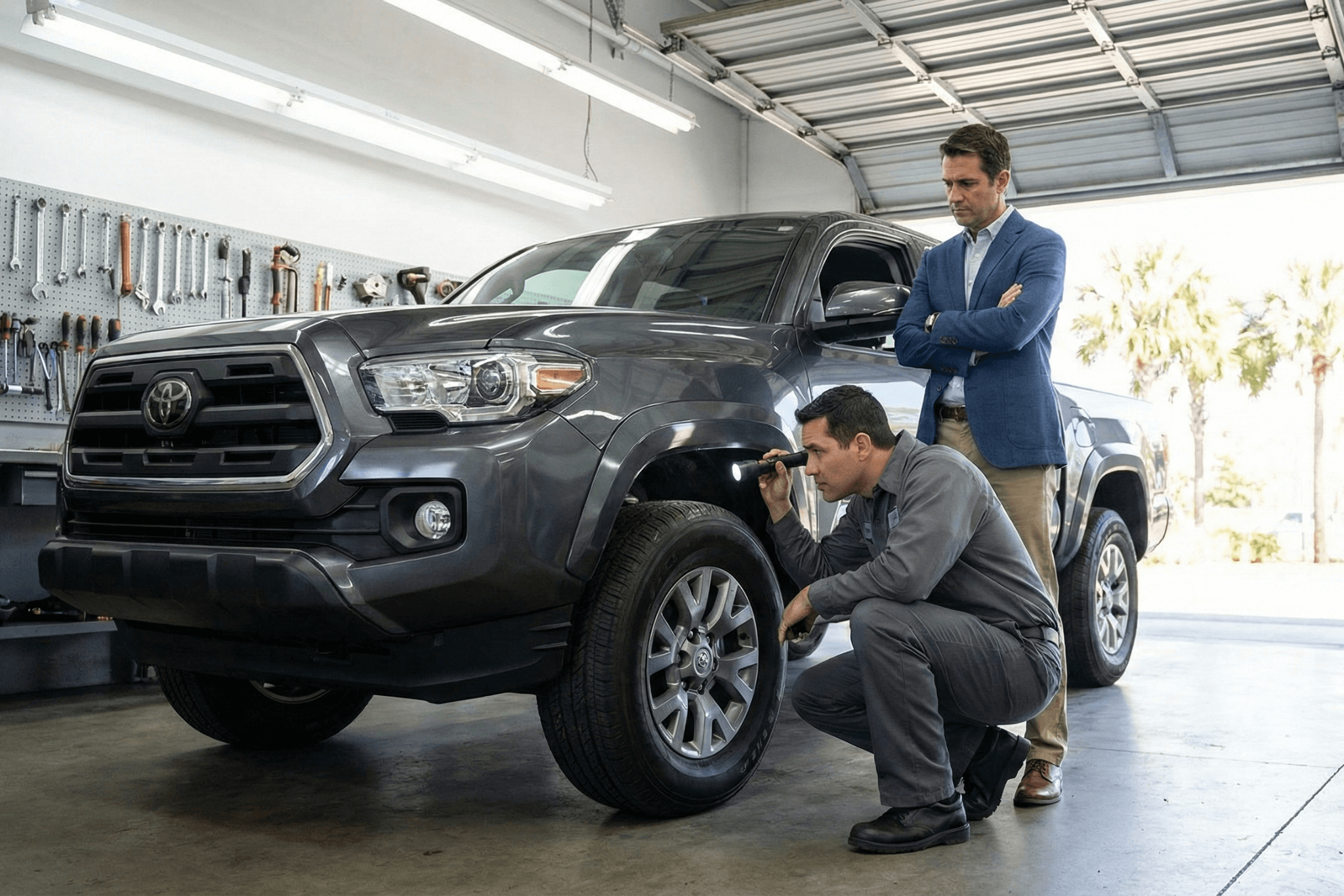
3. Get a pre-purchase inspection
Pay a trusted mechanic $150-$250 to inspect the vehicle before you buy. For work trucks, ask them to specifically check:
- Frame and undercarriage for rust, damage, or repairs
- Suspension and steering components
- Transmission and drivetrain
- Signs of heavy towing (hitch wear, transmission condition)
- Electrical systems
At Destin Autos: We provide vehicle history reports on our inventory and welcome pre-purchase inspections. Ask your sales representative for the Carfax or AutoCheck report on any vehicle you’re considering.
Common Mistakes to Avoid
What we’ve seen trip up business buyers over the years
After years of helping business owners find work vehicles, we’ve noticed a few patterns that tend to come up. None are deal-breakers. But knowing about them ahead of time can save you money and hassle.
Mistake #1: Buying Based Only on Tax Benefits
Yes, Section 179 is powerful. No, it doesn’t make a $50,000 truck free. You’re still writing a check for $50,000. The deduction simply reduces your tax bill.
It happens more than you’d think. A business owner picks up a $55,000 one-ton dually because their accountant mentioned Section 179. Then they realize they run a property management company that never tows anything heavier than a pressure washer. Six months later, they’re spending $120 a week on fuel for a truck that’s wildly overbuilt for their actual needs.
Better approach: Figure out what vehicle your business actually requires. Then maximize the tax benefits on that purchase. Not the other way around.
Mistake #2: Not Tracking Business Use
If you use a vehicle for both business and personal, you must track and document the business percentage. This isn’t optional. It’s an IRS requirement.
Without records, an auditor doesn’t reduce your deduction. They eliminate it entirely. Every dollar you claimed on that truck becomes taxable income, plus penalties and interest.
Better approach: Download a mileage tracking app on day one. Log every trip with the date, destination, purpose, and miles. It takes 10 seconds per trip. It could save you thousands in an audit.
Mistake #3: Underestimating Total Cost of Ownership
The purchase price is just the down payment on what this vehicle will actually cost your business. A $35,000 truck can easily run $8,000-$12,000 per year in operating costs on top of the purchase. Most owners don’t run those numbers until they’re already making payments:
- Commercial insurance (higher than personal)
- Fuel (work vehicles often get poor mileage)
- Maintenance (heavy use means more frequent service)
- Upfitting and modifications
- Signage and wraps
Mistake #4: Waiting Until Year-End
Every December, business owners scramble to buy a truck before year-end to capture the Section 179 deduction. By then, inventory is thinner and the rush to close before January 1st can lead to compromises on specs, condition, or price.
One contractor told us he overpaid by $4,000 on a truck in December that he could have gotten for less in September. The tax savings didn’t make up the difference.
Better approach: Plan purchases in Q1 or Q2. You’ll have the full year’s inventory to choose from and plenty of time to find exactly what you need.
Mistake #5: Not Considering Resale Value
Business vehicles get replaced every 3-7 years for most owners. When that day comes, some vehicles hand you back a meaningful chunk of your investment. Others don’t. Factor resale into your buying decision. It’s part of the total cost equation:
- Toyota Tacoma, Tundra. Among the strongest resale in the truck market. You’ll pay more upfront, but you’ll get more back.
- Ford F-150, F-250. Solid resale, especially in popular trims. Huge parts availability keeps them practical long-term.
- RAM 1500. Good resale when well-maintained, though historically a step behind Toyota and Ford.
- Domestic full-size vans. Lower resale values. These are workhorses, not investments. Buy them to use hard and replace.
Emerald Coast Business Needs
What actually works for local industries, and why
The Emerald Coast runs on tourism, construction, marine services, and a whole lot of HVAC calls in the summer.
Each industry has its own vehicle demands. Salt air eats metal. Sandy roads punish undercarriages. And the reality of running a business where the beach is never more than 15 minutes away creates unique requirements. Here’s what tends to work well for local operators.
| Industry | Common Vehicle Needs |
|---|---|
| Construction/Contractors | Heavy-duty trucks (F-250, Silverado 2500), trailers for equipment |
| Fishing Charters | Trucks with towing capacity for boat trailers, corrosion resistance |
| HVAC/Plumbing/Electrical | Cargo vans with shelving, service bodies on trucks |
| Landscaping | Trucks with trailer towing, dump beds, crew cabs for workers |
| Property Management | Reliable trucks or SUVs for site visits, light hauling |
| Tour Operators | Passenger vans, SUVs for small group transport |
| Real Estate | Professional SUVs or sedans for client transport |
A few things worth noting for anyone operating on the coast.
Charter captains and marine services should prioritize corrosion resistance. Salt air is brutal on exposed metal, and a truck that sits at a marina every day takes a beating that a landlocked vehicle never sees. Undercoating and regular washing aren’t luxuries here. They’re maintenance requirements.
HVAC and plumbing contractors don’t get an off-season in this climate. Your van runs 12 months a year, so reliability and cooling capacity matter more than anything on the options list.
And landscaping crews dealing with sandy soil and tight condo parking lots in Destin and 30A need to think carefully about whether a full-size crew cab actually fits where they’re working every day.
See what’s on the lot: We stock work trucks, cargo vans, and SUVs for Emerald Coast businesses. Browse work trucks in stock right now →
Frequently Asked Questions
No, most small business owners don’t need a CDL. A commercial driver’s license is typically required only for vehicles over 26,000 lbs GVWR, vehicles towing trailers over 10,000 lbs (with combined weight over 26,000 lbs), or vehicles designed to transport 16+ passengers. Most pickups, vans, and SUVs fall well under these thresholds. Check Florida DMV requirements for your specific situation.
You can only deduct the business-use percentage. For example, if you use the vehicle 70% for business, you deduct 70% of expenses or 70% of the Section 179 amount. You must keep mileage logs to document business use. The vehicle must be used more than 50% for business to qualify for Section 179.
Yes, Section 179 applies to used vehicles. The vehicle just needs to be “new to you,” meaning you haven’t used it in your business before. You can buy a used truck or van and claim Section 179 as long as it meets the GVWR and business-use requirements and is placed in service during the tax year.
Check the sticker on the driver’s door jamb. It lists the GVWR (Gross Vehicle Weight Rating). You can also find it in the owner’s manual or by searching the vehicle’s specs online using the VIN. GVWR matters for Section 179 because vehicles over 6,000 lbs qualify for higher deductions.
Yes, you can finance a business vehicle through the dealership. At Destin Autos, you can finance under your business name (requires business credit and financials) or personally using your personal credit. Our finance team can help you explore both options.
Yes, if the vehicle is titled to your business, you almost certainly need commercial auto insurance. Personal auto policies usually exclude business use and may deny claims if an accident occurs while you’re working. If you use a personal vehicle for occasional business purposes, consider adding Hired and Non-Owned Auto (HNOA) coverage to fill the gap.
You may owe taxes on the sale through depreciation recapture. Any gain up to the amount of depreciation you claimed is taxed as ordinary income, not capital gains. For example, if you claimed $40,000 in Section 179 and sell the vehicle for $20,000, that $20,000 is added to your taxable income for that year. Report the sale on IRS Form 4797.
Florida charges 6% state sales tax on vehicle purchases. Okaloosa County adds a 1% surtax on the first $5,000 of the purchase price. There are no special exemptions for business vehicle purchases. If you’re trading in a vehicle, the trade-in value is subtracted from the purchase price before tax is calculated.
Yes, but you can’t switch methods later. You must choose between Section 179 and the standard mileage rate in the first year. For 2026, the IRS standard mileage rate is 72.5 cents per mile. If you claim Section 179 or bonus depreciation on a vehicle, you must use the actual expense method for that vehicle going forward.
Get a vehicle history report from Carfax or AutoCheck using the VIN. The report shows accident history, number of previous owners, service records, and title status (salvage, flood, rebuilt). For work trucks, also check for signs of heavy commercial use. Always get a pre-purchase inspection from a trusted mechanic before buying.
For a business vehicle, a clean title is usually worth the extra cost. Salvage and rebuilt titles mean the vehicle was previously declared a total loss, usually due to accident or flood damage. These vehicles can be harder to insure, harder to finance, and have lower resale value. If you do consider one, get a thorough inspection and understand the full history before committing.
Work Vehicles in Stock
Business-ready trucks and SUVs at Destin Autos


2024 Chevrolet Silverado 1500 RST
Crew Cab 4WD • 30,556 miles
VIN: 1GCUDEEL7RZ208195
$51,337
View Details →
2024 Ford F-150 King Ranch
SuperCrew 4WD • 50,389 miles
VIN: 1FTFW6L82RFA67254
$58,264
View Details →
2022 Chevrolet Tahoe Z71
Sport Utility 4WD • 96,622 miles
VIN: 1GNSKPKD2NR186694
$41,114
View Details →Ready to Find Your Business Vehicle?
At Destin Autos in Fort Walton Beach, we’ve helped hundreds of Emerald Coast business owners find the right work vehicles. Contractors who need a truck that can tow. Charter captains who need one that can handle salt air. If you know what you need, we’ll help you find it. If you’re still figuring it out, that’s fine too. That’s what we’re here for.
Your Next Steps
- Talk to your accountant about Section 179 and how a vehicle purchase fits your tax picture this year
- Pin down your payload, towing, and cargo requirements
- Set a total budget: purchase price plus upfitting, insurance, and fuel
- See what work trucks we have on the lot right now
- Have questions? Call Kelly’s team at (888) 762-1356. We talk to business owners about this stuff every day.
Helpful Resources
- IRS Publication 946: How to Depreciate Property (includes Section 179)
- Section179.org: Calculator and current year limits
- Kelley Blue Book: Vehicle values and pricing
- Florida DMV: Commercial driver’s license requirements

Disclaimer: The information provided in this guide is for general educational purposes only and does not constitute tax, legal, or professional advice. Section 179 rules, deduction limits, and vehicle qualifications vary based on individual circumstances and are subject to change. Always consult a qualified tax professional or accountant before making purchase decisions based on tax benefits. Vehicle availability, pricing, and features are subject to change without notice. Last updated: February 21, 2026.