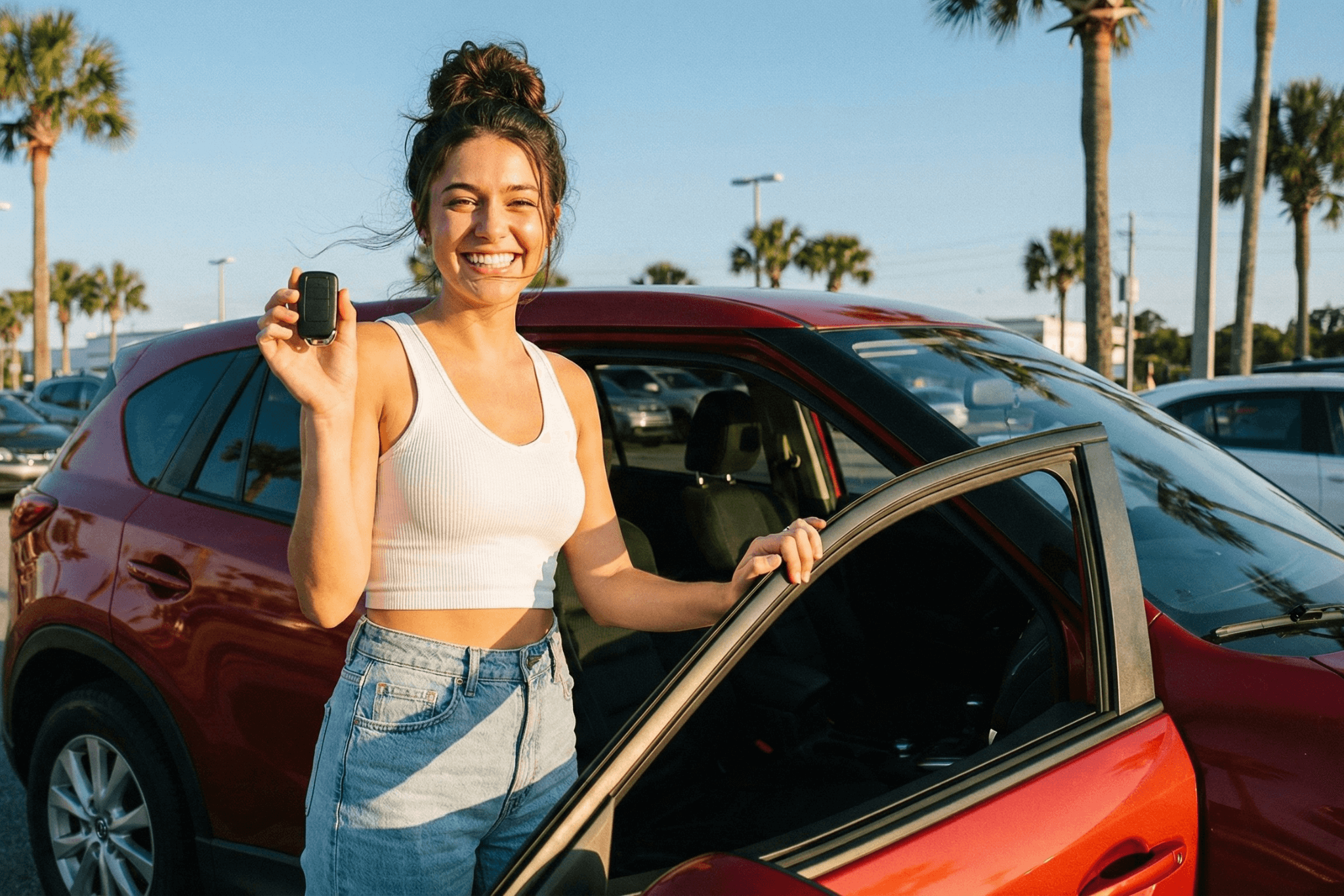
Buying your first car is a big deal. Whether you’re a student, a recent graduate, or someone who just never needed a car until now, the process can feel overwhelming when you don’t know what to expect.
At Destin Autos in Fort Walton Beach, we work with first-time buyers from across the Emerald Coast every week. This guide walks you through how to buy a used car for the first time, step by step.
What’s In This Guide
- Quick-start checklist for first-time buyers
- Figuring out what you can actually afford
- Understanding credit scores and interest rates
- Getting pre-approved for financing
- Dealership vs. private seller
- What to look for in a used car
- The test drive: What to Check
- Understanding the paperwork
- Avoiding common first-time buyer mistakes
- After the purchase: Insurance, Registration, and Maintenance
First-Time Buyer Checklist
Get these done before you visit any dealership
- Know your budget. Total monthly car costs should stay under 15–20% of your take-home pay. That includes the payment, insurance, gas, and maintenance.
- Check your credit score. Use AnnualCreditReport.com (free) or apps like Credit Karma. Knowing your score helps you understand what rates to expect.
- Get pre-approved. Apply with your bank, credit union, or an online lender first. This gives you a rate to compare against other financing options.
- Research prices. Look up the car you want on Kelley Blue Book or Edmunds. Know the fair market value before you walk in.
- Gather your documents. Driver’s license, proof of income (pay stubs), proof of insurance, and proof of residence (utility bill). Having everything ready speeds up the process.
These five steps put you in control. You’ll know what you can afford, what rate you qualify for, and what the car should cost.
That kind of preparation makes the whole process smoother.

What Can You Actually Afford?
The real numbers most guides don’t tell you
Most first-time buyers focus only on the monthly payment. But that’s just one piece of the picture.
The monthly payment is just one piece of owning a car. Here’s the full picture:
| Cost | What It Is | Typical Range |
|---|---|---|
| Car payment | Your loan payment | Varies by price and term |
| Insurance | Required if you have a loan (full coverage) | $200–$550/month for drivers under 25 in Florida |
| Gas | Based on how much you drive | $100–$250/month |
| Maintenance | Oil changes, tires, repairs | $50–$100/month (set aside) |
| Registration & taxes | Title, tag, and sales tax (Florida: 7% in Okaloosa County) | One-time + annual renewal |
Insurance costs are significantly higher for drivers under 25 in Florida. Rates vary by driving history, vehicle type, and insurer. Florida averages $550/month for young driver full coverage.
The 15% Rule
A common guideline: keep your total car payment under 15% of your monthly take-home pay.
If you bring home $3,000/month after taxes, that’s $450/month max for your car payment.
But that doesn’t include insurance, gas, or maintenance. If you’re a young driver in Florida paying $300–$500/month for insurance, factor that in before you shop.
A note on long loan terms. A 72 or 84-month loan lowers your monthly payment. But you’ll pay more interest overall and could end up owing more than the car is worth. That’s called being “underwater.”
How Much Should You Put Down?
More down payment means a lower monthly payment and less interest paid.
Just keep enough in savings for emergencies. You don’t want to put every dollar into the car and have nothing left for unexpected expenses.
| Down Payment | Pros | Cons |
|---|---|---|
| $0 down | Keep cash on hand | Higher payment, more interest, risk of being underwater |
| 10% down | Balance of payment and savings | Still may be underwater early in loan |
| 20% down | Lower payment, less interest, builds equity faster | Requires more cash upfront |
For first-time buyers: Aim for at least 10% down if possible. It shows lenders you’re serious and helps you get a better rate. Learn about our financing options
Buying a used car for cash? If you’ve saved enough to pay the full price, you skip financing entirely. No monthly payments. No interest. A simpler transaction.
Just make sure you keep enough in savings for insurance, registration, and unexpected repairs. Browse our inventory to find cars in your budget.
Understanding Credit Scores
What lenders see and how it affects your rate
Your credit score is a number between 300 and 850. It tells lenders how risky it is to lend you money.
Higher score means lower risk. Lower risk means a better interest rate.
| Credit Score | Rating | What to Expect |
|---|---|---|
| 750+ | Excellent | Best rates available |
| 700-749 | Good | Competitive rates |
| 650-699 | Fair | Decent rates, may need more documentation |
| 600-649 | Below Average | Higher rates, may need larger down payment |
| Below 600 | Poor | Limited options, higher rates, may need co-signer |
Credit score ranges and rate impacts vary by lender. This is general guidance only.
No Credit vs. Bad Credit
They’re different. And lenders treat them differently.
“No credit” means you haven’t borrowed money before. That’s common for young people. “Bad credit” means you’ve borrowed and had trouble paying it back.
No credit is easier to work with. Some lenders have “first-time buyer” programs specifically for people with thin credit files.
A co-signer (like a parent with good credit) can also help you qualify for better rates.
Building Credit Before You Buy
If you have time, consider building credit for a few months before buying:
- Get a secured credit card and pay it off monthly
- Become an authorized user on a parent’s card
- Pay all bills on time. Some rent payments can be reported to credit bureaus.
Even 3-6 months of positive credit activity can make a difference.
Getting Pre-Approved
Why this is the most important step
Pre-approval means a lender has reviewed your credit and income. They’ve agreed to lend you up to a certain amount at a specific interest rate.
This is different from pre-qualification, which is just an estimate. Pre-approval is a real commitment from the lender.
Why Pre-Approval Matters
- You know your actual rate and budget before you shop
- You can compare dealer financing to your pre-approved rate
- You can compare multiple financing options and pick the best rate
- The process is faster at the dealership
Where to Get Pre-Approved
Credit unions Often have the best rates, especially for members. Check if you’re eligible for any (through work, school, or family).
Banks Your existing bank may offer a rate discount for customers.
Online lenders Companies like Capital One Auto, LightStream, and others let you apply online and compare rates quickly.
Rate shopping tip: If you apply to multiple lenders within 14–45 days (depending on the scoring model), all the inquiries count as one for your credit score. Do them close together. Don’t spread your applications over months.
Local option: Our finance team at Destin Autos works with multiple lenders to find competitive rates. If you’re not sure where to start with pre-approval, we can help you explore options when you visit. Get pre-approved online
Dealership vs. Private Seller
Where you buy matters as much as what you buy
You have two main options when buying a used car. Each one comes with tradeoffs.
Buying from a Dealership
Dealerships handle the paperwork. Title transfer, registration, tax collection. It’s all done for you.
Most dealerships offer financing on-site. That means you can compare their rate against your pre-approval and pick the better deal. Many also offer warranties or certified pre-owned programs that give you some protection after the sale.
The downside? Prices may be slightly higher than private sellers. That’s because you’re paying for convenience, financing access, and (in many cases) a vehicle that’s been inspected.
Buying from a Private Seller
Private sellers sometimes offer lower prices. But everything else falls on you.
You handle the title transfer. You arrange your own financing ahead of time. There’s no warranty. And there’s no legal requirement for the seller to disclose problems in most private sales.
You’ll also need to visit the DMV yourself for registration and pay sales tax directly to the state.
| Dealership | Private Seller | |
|---|---|---|
| Financing | Available on-site | Arrange your own |
| Warranty | Often available | None (as-is) |
| Paperwork | Dealer handles it | You handle it |
| Price | May be slightly higher | May be slightly lower |
| Recourse if problems | Dealer reputation + possible warranty | Very limited |
Our recommendation for first-time buyers: Start with a dealership. The financing access, paperwork support, and potential warranty coverage make the process much less stressful when you’re doing this for the first time.
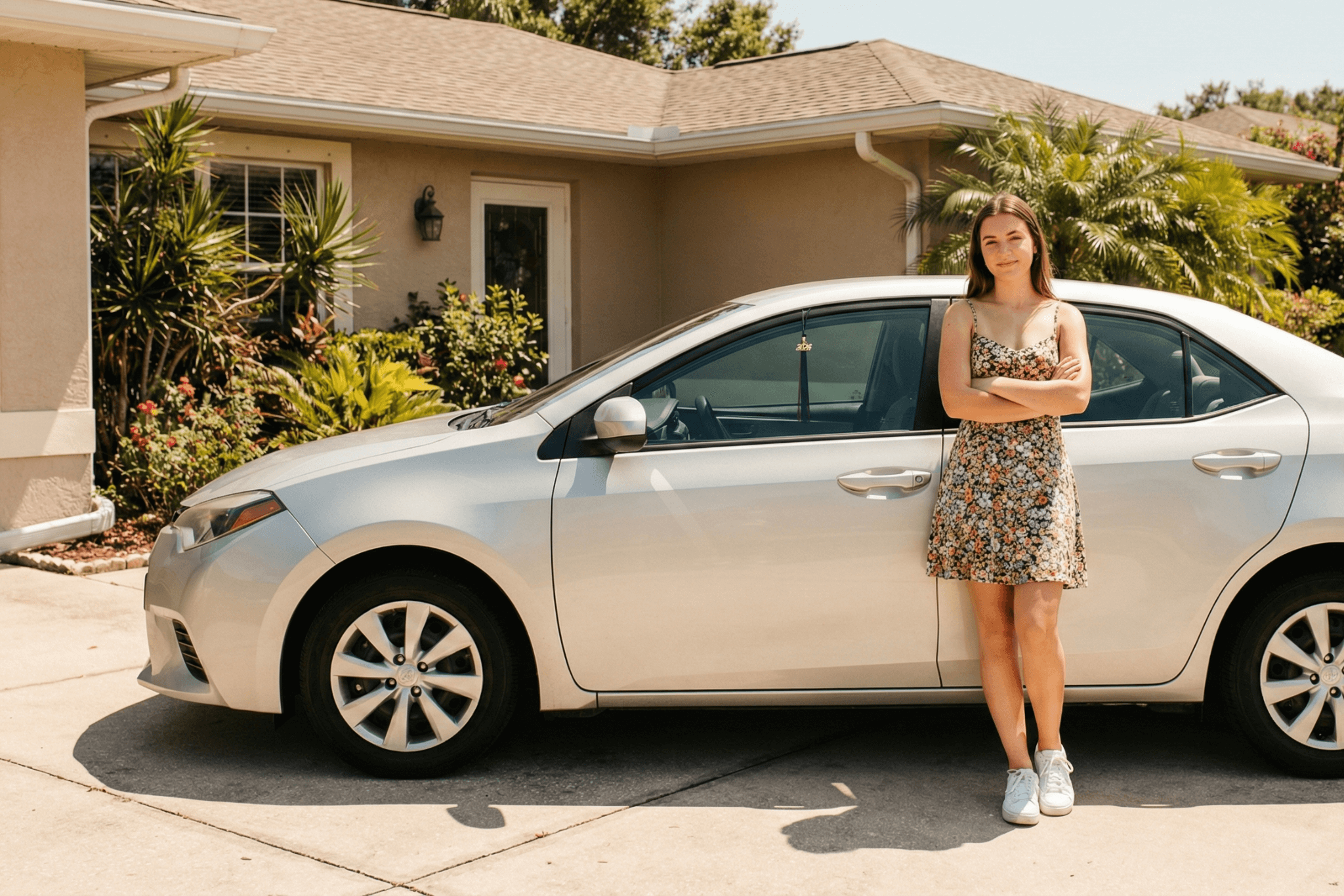
What to Look For in a Used Car
How to check a used car before buying
You’ve done your homework. You have financing lined up. Now it’s time to look at actual cars.
Here’s what to check before you buy:
Before You Visit
- Vehicle history report — Ask for Carfax or AutoCheck. Look for accidents, title issues, service history, and number of previous owners.
- Mileage — Average is about 12,000–13,500 miles per year. A 5-year-old car with 60,000 miles is normal. One with 100,000+ has been driven hard.
- Reliability ratings — Check Consumer Reports or J.D. Power for the specific year/model.
At the Dealership
- Exterior — Look for uneven paint (sign of repairs), rust, dents, and tire wear
- Interior — Check for wear on seats, pedals, and steering wheel. Excessive wear might indicate higher use than the odometer shows.
- Under the hood — Look for fluid leaks, corrosion, and condition of belts/hoses
- Underneath — Check for rust, oil leaks, or obvious damage
Consider a pre-purchase inspection. For $150-$250, an independent mechanic will inspect the car thoroughly. This is especially important for cars without warranty coverage.
At Destin Autos: Every vehicle in our inventory is carefully inspected before it goes on the lot. We’re happy to share what we know about each car’s history and condition. Just ask.
The Test Drive
What to actually check
A test drive isn’t just about whether you like the car. It’s your chance to find problems before they become yours.
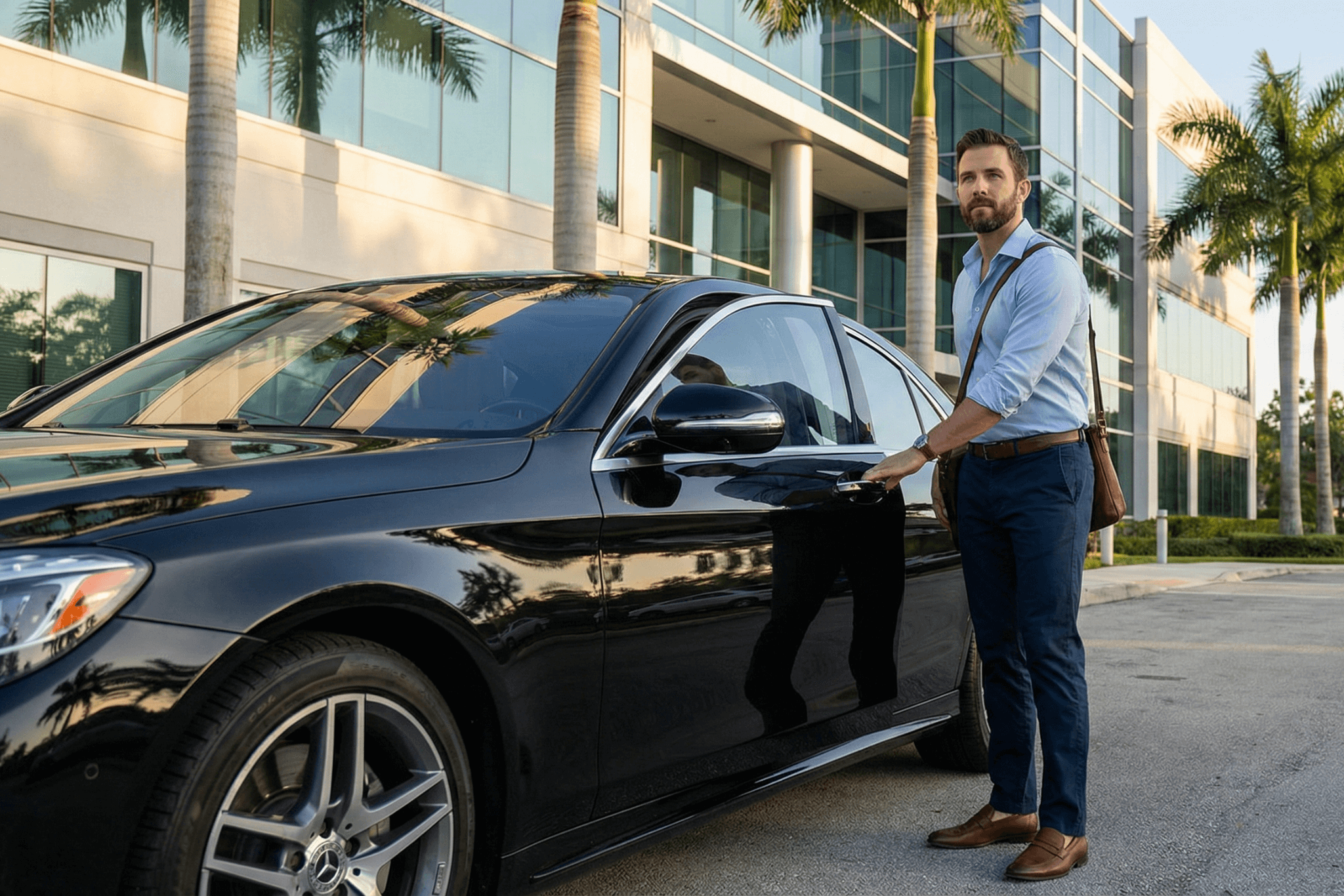
During the Test Drive
- Cold start — Ask to start the car when the engine is cold. Problems often hide when the engine is warm.
- Brakes — Do they feel firm? Any pulling to one side? Grinding or squealing?
- Steering — Does the car track straight? Any vibration in the wheel?
- Transmission — Smooth shifting? Any hesitation or jerking?
- Highway driving — Get it up to highway speed. Any vibration or noise?
- AC and heat — Test both. AC repairs can be expensive.
- All electronics — Windows, locks, radio, backup camera, everything
Drive for at least 20–30 minutes. Take the route you’d normally drive. If you commute on the highway, test it on the highway. Schedule a test drive at Destin Autos.
Understanding the Paperwork
What you’re actually signing
When you buy a car, you’ll sign several documents. Here’s what the main ones mean:
The Bill of Sale
This is the official record of the transaction. It includes the vehicle details, sale price, and names of buyer and seller. Check that all information is accurate.
The Buyer’s Guide
Required by the FTC. It tells you whether the car is sold “as is” or with a warranty.
Read this carefully. If it says “as is,” you’re responsible for every repair the moment you leave the lot.
The Finance Contract
If you’re financing, this is the loan agreement. Look for:
- APR (Annual Percentage Rate) — The true cost of borrowing, including fees
- Total amount financed — Should match the car price minus your down payment
- Total of payments — The total you’ll pay over the life of the loan
- Monthly payment and term — Confirm these match what you agreed to
Check every field before signing. Make sure every line is filled in and matches what you agreed to. If something looks off, ask about it. A good dealership will walk you through every document.
Warranties and Add-Ons
The finance team may also walk you through additional products like extended warranties, GAP insurance, paint protection, or tire protection.
Some can be valuable. Others may not be worth it for your situation. You don’t have to decide on the spot.
How to buy a warranty for a used car: You can often buy an extended warranty later. Just make sure to do it before your factory warranty expires (if any remains).
GAP insurance is often available through your auto insurance company as well as the dealership. Compare both options to get the best price.
Common First-Time Buyer Mistakes
What first-time buyers often wish they knew sooner
Mistake #1: Focusing Only on Monthly Payment
A longer loan term lowers your monthly payment. But it costs more overall.
Here’s what a $20,000 car at 11% interest looks like (close to the current used car loan average of ~11.4%):
| Loan Term | Monthly Payment | Total Interest Paid |
|---|---|---|
| 48 months | ~$517 | ~$4,800 |
| 60 months | ~$435 | ~$6,100 |
| 72 months | ~$381 | ~$7,400 |
Example calculations for illustration. Actual payments depend on your rate and loan terms.
That 72-month loan saves you $136/month. But it costs $2,600 more in interest over the life of the loan.
Mistake #2: Skipping the Pre-Approval
Without a pre-approved rate, you have no baseline to compare. Having your own rate in hand helps you evaluate any financing offer and pick the best one.
Mistake #3: Buying Too Much Car
It’s tempting to stretch for the nicer car. Don’t.
Being “car poor” means your car payment strains everything else in your life. Buy what you can comfortably afford. Not the maximum you qualify for.
Mistake #4: Not Getting Insurance Quotes First
Insurance on a sports car or luxury vehicle can be significantly higher than on a practical sedan. Get insurance quotes on the specific cars you’re considering before you commit.
Mistake #5: Rushing the Decision
A car is a big purchase. It’s okay to sleep on it.
Take your time. If you feel rushed, it’s okay to step back and think it over. The right car will still be there tomorrow.
At Destin Autos, we’re happy to answer questions at your own pace. Reach out anytime.
After the Purchase
What happens next
How to Buy Insurance for a Used Car
You need insurance before you drive off the lot. Most people already have a policy and just add the new car.
If you don’t have insurance yet, get quotes and buy a policy before you pick up the car.
If you’re financing, you’ll need full coverage (comprehensive and collision). Not just liability. Get quotes from multiple insurers. Rates vary significantly, especially for younger drivers.
Registration and Title
In Florida, the dealer handles most of the paperwork and sends it to the DMV. You’ll receive your registration in the mail within a few weeks.
If you paid cash, your title comes in the mail too. If you financed, the lender holds the title until you pay off the loan.
Expect to pay Florida’s 6% state sales tax plus a 1% county surtax (on the first $5,000) in Okaloosa County. Title and registration fees run around $400–$500 total.
First Maintenance
Even with a used car, keep up with maintenance. It protects your investment and prevents small problems from becoming expensive ones.
Check the owner’s manual for the recommended schedule. Or ask the dealer what’s been done recently. Common first-year items:
- Oil change every 5,000-7,500 miles (check your manual)
- Tire rotation every 5,000-7,500 miles
- Check fluid levels monthly
- Address any warning lights immediately
Keep records. Save all receipts for maintenance and repairs. This helps if you ever sell the car and can be important for warranty claims.
Good Used Cars for First-Time Buyers
Reliable, affordable, and practical
These models are known for reliability, low cost of ownership, and reasonable insurance rates:


2021 Honda CR-V Hybrid Touring
AWD SUV · 71,343 miles
Great for families · Hybrid
$26,562
View Details →
2025 Mazda CX-5 Carbon Edition
AWD SUV · 41,692 miles
Fun to drive · Nice interior
$25,397
View Details →Sedans
For most first-time buyers, a sedan is the sweet spot. Lower insurance rates. Better fuel economy. Easier to park.
- Honda Civic — Excellent reliability. Holds value well. You’ll see plenty on the road for a reason.
- Toyota Corolla — One of the most reliable cars ever made. Maintenance costs are low. Nothing flashy, but it just works.
- Mazda3 — More fun to drive than most in this class. Reliable and affordable.
- Hyundai Elantra — Good value. Newer models come with longer warranties, which is reassuring for a first car.
SUVs and Crossovers
Need more space? A compact crossover gives you room without the fuel costs of a full-size SUV. Insurance tends to be reasonable too.
- Honda CR-V — Practical, reliable, and holds resale value. A great all-around family car.
- Toyota RAV4 — Durable and fuel-efficient for an SUV. One of the best sellers in the country.
- Mazda CX-5 — Drives more like a car than an SUV. Nice interior for the price.
- Subaru Crosstrek — Standard all-wheel drive on every model. Good if you travel north in winter.
Check our current inventory: We stock many of these models. Browse what’s available now
Frequently Asked Questions
Yes, you can buy a car with no credit history. Many lenders offer first-time buyer programs. You may need a larger down payment or a co-signer, and your rate will likely be higher than someone with established credit.
For first-time buyers, a dealership is usually easier. Dealerships offer financing, may include warranties, and handle all the paperwork. Private sellers might have lower prices, but you get no warranty and handle title transfer yourself.
Focus on the total out-the-door price, not just the sticker. Check Kelley Blue Book and Edmunds for fair market value first. If the car is priced at or below market value, there may not be much room. If it’s above, you have more leverage.
GAP insurance is most valuable if you put little money down or have a long loan term. It covers the difference between what you owe and what your car is worth if it’s totaled. Compare pricing from your auto insurance company and the dealership to find the best option.
If you’re financing, full coverage is required by the lender. If the insurance cost makes the total unaffordable, you may need to look at a less expensive car with lower insurance rates. Get insurance quotes before you commit to a vehicle.
About 2–4 hours if you’re prepared. Being pre-approved with your documents ready speeds things up significantly. If you need dealer financing, add extra time for the credit application.
Ready to Start Looking?
At Destin Autos in Fort Walton Beach, we work with first-time buyers from across the Emerald Coast every week. We’re happy to answer questions and help you find the right fit.
We’ll walk you through the process, explain your options, and answer every question you have.
Military? We proudly offer military pricing for service members and veterans from Eglin AFB, Hurlburt Field, Tyndall AFB, and other installations. Ask us about military discounts
What to Do Next
- Check your credit score (free at AnnualCreditReport.com)
- Calculate your budget using the guidelines above
- Get pre-approved with your bank, credit union, or through us
- Browse our inventory to see what’s available
- Contact us when you’re ready to visit
Helpful Resources
- AnnualCreditReport.com: Free credit reports from all three bureaus
- Kelley Blue Book: Vehicle values and pricing
- Edmunds: Car reviews and pricing tools
- Consumer Reports: Reliability ratings (subscription required)
Disclaimer: The information provided in this guide is for general educational purposes only and does not constitute financial or professional advice. Interest rates, loan terms, and vehicle prices vary based on creditworthiness, market conditions, and other factors. Always verify current rates and terms directly with lenders before making financing decisions. Credit score ranges and their impacts are approximate and vary by lender and scoring model. We recommend comparing offers from multiple sources. Vehicle availability, pricing, and features are subject to change without notice. Last updated: February 21, 2026.