13 min read
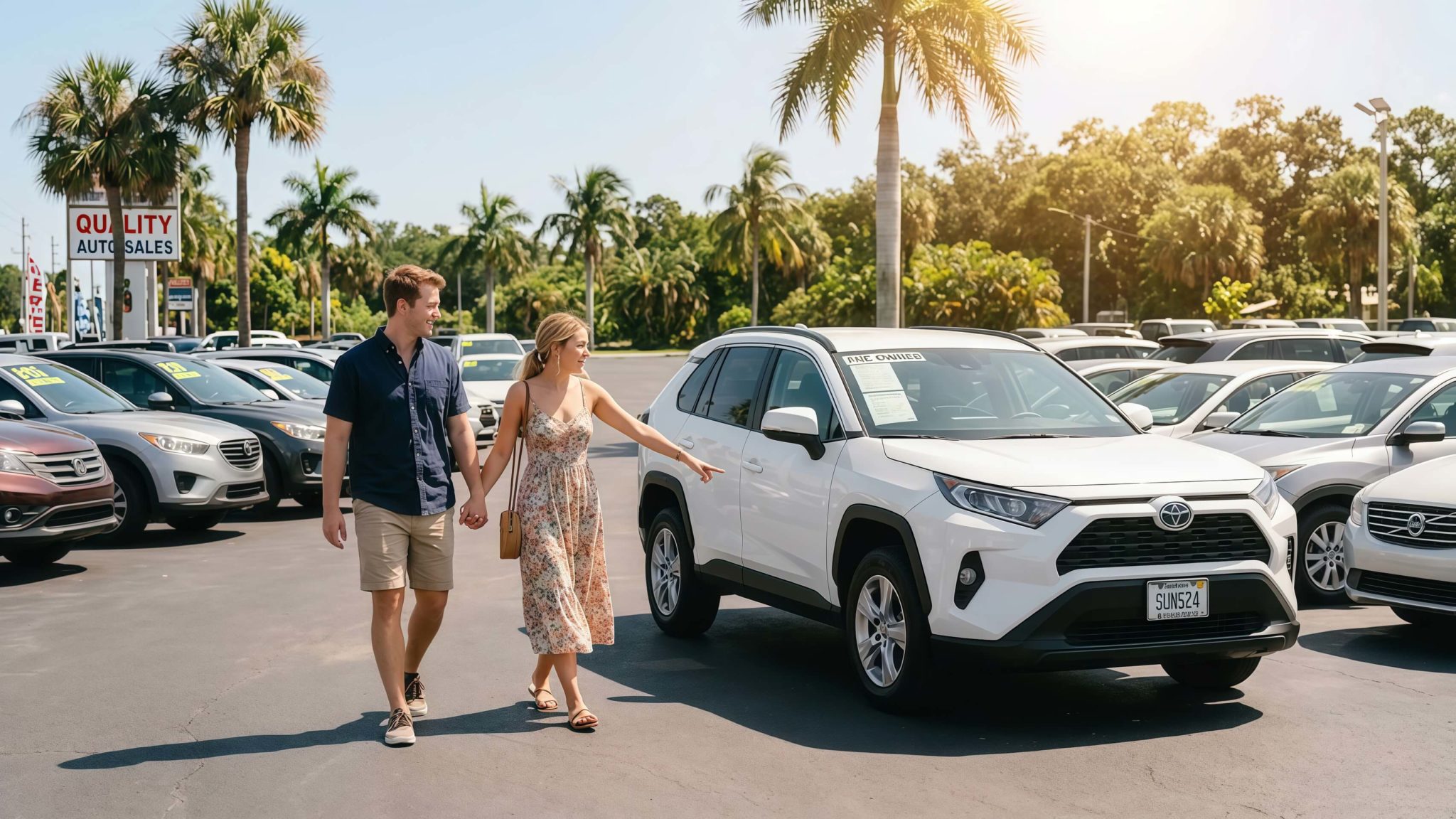
Buying a used car in Florida? There’s more to it than finding the right vehicle. You need a pre-purchase inspection, a vehicle history check, the right paperwork for your county tax collector, and enough set aside for Florida’s 6% sales tax plus your county’s surtax. This guide walks you through every step — from budgeting and inspections to negotiation, lemon law protections, and final registration.
Have questions specific to your situation? Call us at 888-762-1356 or reach out online. We’re happy to walk you through it.
What’s In This Guide
- What to look for when buying a used car in Florida
- How much to budget for a used car in 2026
- Pre-purchase inspections explained
- How to check a used car’s history
- Florida paperwork requirements
- Negotiation strategies that work
- Florida’s used car lemon law protections
- Dealer vs. private seller comparison
- Financing options available
- How to register and title in Florida
What Should You Look for When Buying a Used Car in Florida?
Five critical areas every buyer needs to evaluate
Every used car in Florida needs to be checked across five areas: mechanical condition, body and frame integrity, title status, flood damage history, and safety compliance.
That last one — flood damage — is a big deal here. According to the National Insurance Crime Bureau (NICB), Florida ranks among the top states for flood-damaged vehicles re-entering the market. A thorough undercarriage inspection isn’t optional. It’s essential.
The Florida Department of Highway Safety and Motor Vehicles (FLHSMV) requires any vehicle with a “salvage” or “flood” title brand to disclose that status at sale. But not every seller follows the rules.
Look for rust beneath floor mats. Musty odors. Waterline marks in the engine bay. Mismatched upholstery. These are all signs of flood history. A pre-purchase inspection by a certified ASE mechanic typically costs $100 to $200 — and it can save you thousands.
Used Car Inspection Checklist
- Exterior: Paint consistency, panel gaps, rust spots, tire tread depth (minimum 2/32-inch per Florida law)
- Interior: Dashboard warning lights, seat adjustments, A/C function (critical in Florida), odometer reading
- Under the hood: Fluid levels and color, belt condition, battery terminals, oil leaks
- Undercarriage: Frame damage, exhaust integrity, suspension wear, flood residue or mud
- Test drive: Engine responsiveness, transmission shifts, brake feel, alignment, unusual noises
- Documentation: Title status, service records, recall completion (NHTSA.gov)
Florida-specific concern: Our heat, humidity, and salt air wear down cooling systems, rubber parts, and paint faster than most states. Make sure the A/C works. Check for corrosion on brake rotors and electrical connectors — they degrade quickly in coastal areas like the Emerald Coast.
How Much Should You Budget for a Used Car in 2026?
Sticker price is just the starting point
The national average listing price for a used car is about $25,300 right now, according to Kelley Blue Book. But you don’t have to spend that much.
In the Fort Walton Beach and Destin area, reliable pre-owned vehicles start between $12,000 and $18,000. That’s for models three to six years old with 40,000 to 80,000 miles.
Here’s what catches people off guard: the sticker price isn’t your total cost. Florida adds 8% to 12% on top.
The state sales tax is 6%. Okaloosa County adds a 1.0% surtax — but only on the first $5,000 of the purchase price (per the Florida Department of Revenue). So on a $20,000 vehicle, you’d pay $1,200 in state tax plus $50 in county surtax. That’s $1,250 total in sales tax.
Then there’s the title transfer fee ($75.75) and registration ($14.50 to $32.50 based on vehicle weight). It adds up.
| Cost Category | Estimated Range | Notes |
|---|---|---|
| Vehicle purchase price | $12,000 – $28,000+ | Varies by age, mileage, condition |
| Florida sales tax (6% + surtax) | $720 – $1,680+ | 6% state + surtax on first $5,000 only (Okaloosa: 1%) |
| Title transfer fee | $75.75 | Set by FLHSMV |
| Registration fee | $14.50 – $32.50 | Based on vehicle weight class |
| License plate fee | $28.00 – $48.00 | New plate vs. plate transfer |
| Lien recording fee (if financed) | $2.00 | Per FLHSMV |
| Pre-purchase inspection | $100 – $200 | Independent mechanic recommended |
| Total additional costs | $950 – $2,100+ | Add 8–12% to sticker price |
What You’ll Actually Pay
The True Cost of a $20,000 Used Car in Okaloosa County
That’s $1,536 above sticker price — roughly 7.7% on top. Budget accordingly.
Smart budgeting: Set aside a maintenance reserve of $500 to $1,000 for the first 90 days of ownership to cover any issues that surface after purchase.
What Is a Pre-Purchase Inspection and Why Do You Need One?
The most cost-effective protection available
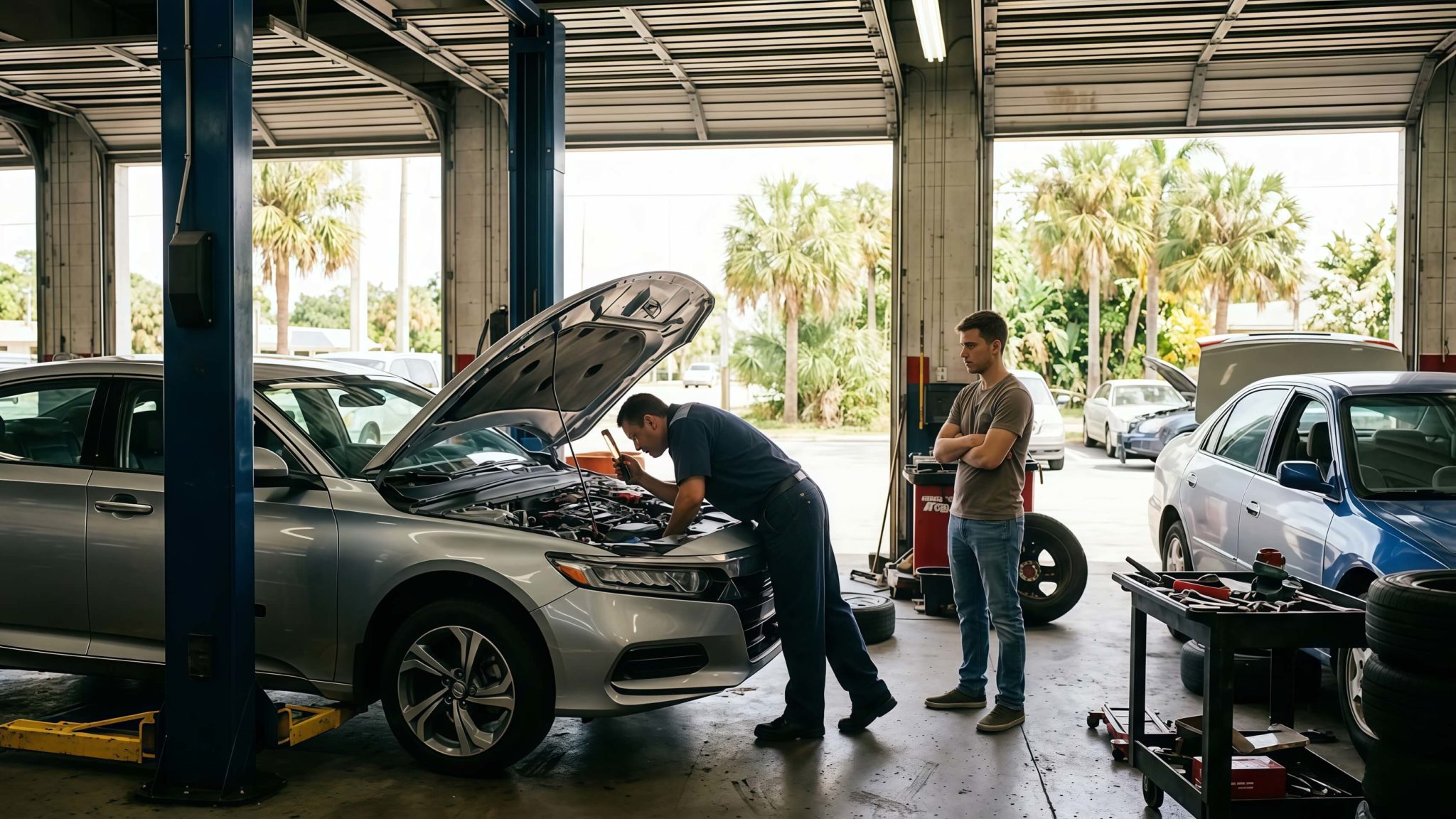
A pre-purchase inspection (PPI) is exactly what it sounds like. You hire an independent mechanic to evaluate the car before you buy it.
Why bother? Because used cars regularly have problems the seller didn’t mention. A PPI catches those issues before they become yours. It covers the engine, transmission, brakes, suspension, exhaust, electrical systems, and body condition. Takes about 60 to 90 minutes.
In Florida, this matters even more. Our heat kills cooling systems. UV damage cracks dashboards and rubber seals. A PPI at an independent shop in Fort Walton Beach runs $100 to $200.
That’s nothing compared to finding out about a $2,000 transmission problem after you’ve signed.
What a PPI Should Cover
- Engine compression and leak-down test — Identifies internal engine wear
- Transmission fluid condition — Burnt fluid signals impending failure ($2,500–$5,000 repair)
- Brake pad thickness and rotor condition — Coastal salt air accelerates corrosion
- Cooling system pressure test — Florida heat demands a flawless cooling system
- OBD-II diagnostic scan — Reveals stored and pending trouble codes, even if the check engine light is off
- Frame and structural inspection — Detects prior collision damage or flood warping
Red flag: Any reputable dealer will welcome a PPI. If a seller won’t let you bring in your own mechanic? Walk away.
How Do You Check a Used Car’s History in Florida?
Two checks, five minutes, zero excuses
Run the VIN through at least two sources. First, the NMVTIS. It’s federally mandated and costs $0 to $10. Second, a commercial service like Carfax or AutoCheck — $25 to $40 per report.
Why both? Because about 800,000 vehicles per year get declared total losses by insurance companies. A lot of them end up back on the market with repaired titles.
Florida law (Statute 319.14) requires disclosure of salvage, flood, or rebuilt title brands. But private sellers don’t always follow through. That’s why you cross-check.
Use the NICB’s free VINCheck tool for theft and total loss history. Check for open recalls at NHTSA.gov. Five minutes. Free.
Vehicle History Red Flags
| Red Flag | What It Indicates | Action |
|---|---|---|
| Salvage or flood title | Prior total loss or flood damage | Avoid unless deeply discounted and inspected |
| Odometer discrepancy | Potential fraud (federal crime) | Walk away; report to FLHSMV |
| Multiple owners, short timeframes | Possible recurring mechanical issues | Request full service records |
| Gaps in service history | Deferred maintenance | Have PPI focus on neglected systems |
| Auction-sourced from flood states | Elevated flood risk | Inspect undercarriage for mud/silt |
| Open safety recalls | Unresolved defects | Verify completion before purchase |
Florida-specific note: Our coastal geography and hurricane exposure make flood checks critical here. Florida leads the nation in flood-damaged vehicles on the road. Always verify the title in person. Make sure the VIN on the dashboard matches the title document and the door jamb sticker.
What Paperwork Do You Need to Buy a Used Car in Florida?
Everything you need for a legal purchase
Here’s what you need to legally buy and register a used car in Florida:
The signed vehicle title with the seller’s notarized signature. A completed Form HSMV 82040. Proof of Florida insurance ($10,000 PIP and $10,000 PDL minimum, per Florida Statute 627.736). A valid photo ID. And payment for all taxes and fees.
You’ve got 30 days from the purchase date to complete the title transfer. Miss that deadline and you’ll owe a $20 late fee.
Buying from a dealer? They handle the paperwork and submit it to the Okaloosa County Tax Collector’s office for you. Buying privately? That’s all on you.
| Document | Private Sale | Dealer Purchase |
|---|---|---|
| Signed vehicle title | You obtain from seller | Dealer provides |
| Bill of sale | Recommended (not required in FL) | Dealer provides |
| HSMV 82040 | You complete and submit | Dealer submits |
| Odometer disclosure | Required on title or separate form | Dealer handles |
| Proof of FL insurance | You provide at registration | You provide at purchase |
| Valid photo ID | Required | Required |
| Lien satisfaction | Verify lien is cleared first | Dealer handles |
| VIN verification (HSMV 82042) | Required if out-of-state title | Dealer handles |
Okaloosa County residents: You can handle everything at the Tax Collector’s office at 1250 Eglin Parkway NE, Shalimar, FL 32579. Some documents can also be processed online at OkaloosaTax.com.
How Do You Negotiate the Best Price on a Used Car?
Research first, then negotiate with facts
Good negotiation starts before you ever set foot on a lot. Check the vehicle’s fair market value on KBB, Edmunds, and NADA Guides. Compare at least three to five listings for the same year, make, model, and mileage within 100 miles of Fort Walton Beach.
Here’s good news for Florida buyers: according to iSeeCars, used car prices in Florida run 2% to 4% below the national average. High inventory and year-round selling season work in your favor.
Per Edmunds, the average buyer who negotiates saves $1,200 to $2,500 off the asking price. But you need to show up prepared. Bring your PPI report, your vehicle history findings, and your comparable pricing data. Facts win negotiations.
- Research fair market value — KBB Private Party for private sales; KBB Dealer Retail for dealers
- Identify leverage points — high mileage, cosmetic damage, needed maintenance, time on lot
- Let the seller name the first number — anchor downward using your research
- Present your PPI findings — documented repairs justify $500 to $3,000+ in reductions
- Negotiate the out-the-door price — total cost, not monthly payment
- Decline unnecessary add-ons — often available independently for less
- Be ready to walk away — leave your info and follow up in 48–72 hours
Timing matters: Per Edmunds, the best time to buy is the last week of the month, the last quarter of the year, and right after new model releases when trade-in inventory spikes.
What Are Florida’s Used Car Lemon Law Protections?
Know what’s covered — and what’s not
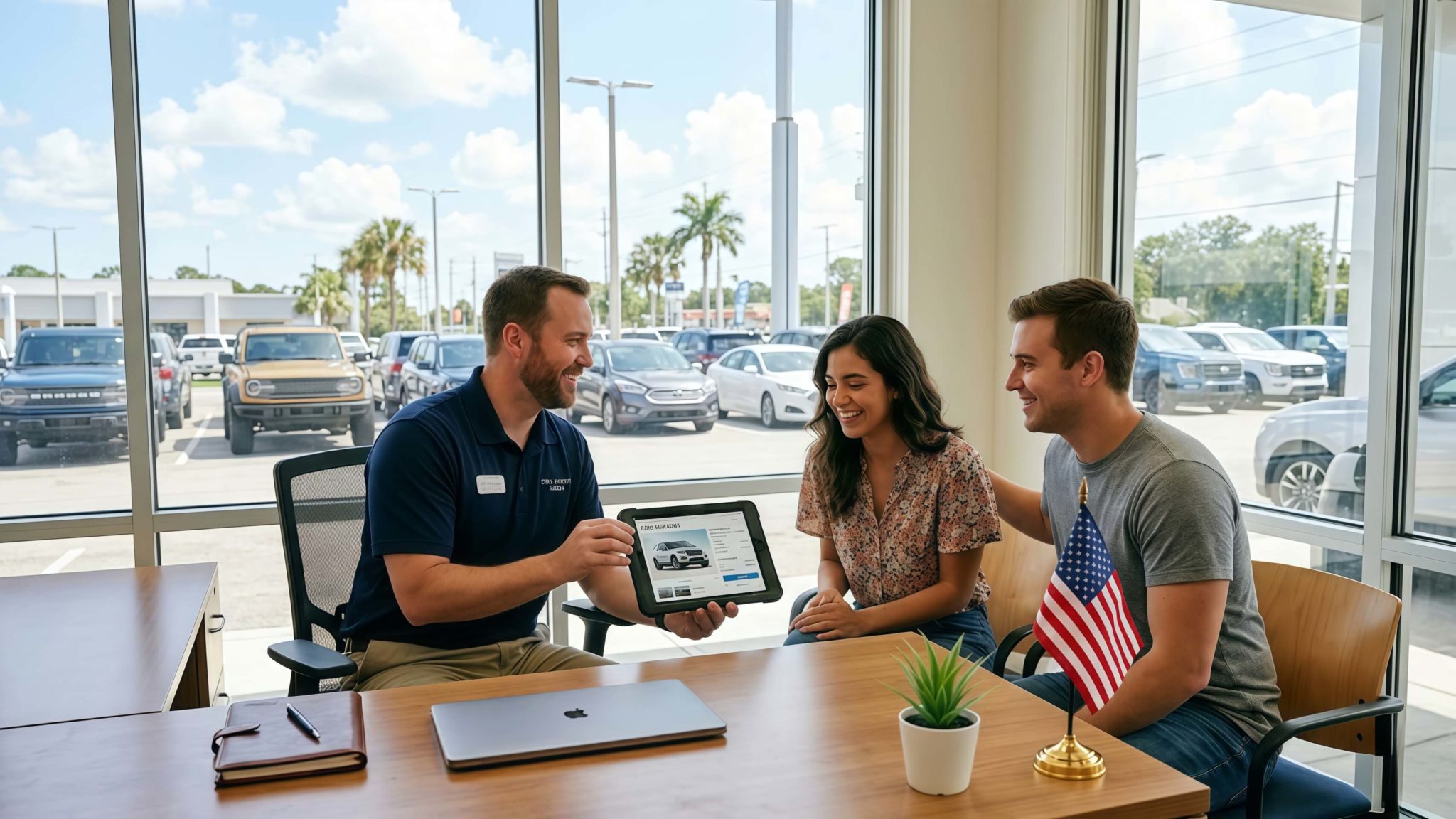
Florida does have a used car lemon law. But it’s more limited than most people think.
Officially called the Motor Vehicle Warranty Enforcement Act (Florida Statute 681), it only applies to used cars still covered under the manufacturer’s original warranty or a dealer-provided warranty. Bought “as-is”? The lemon law doesn’t apply.
For qualifying vehicles, the defect has to be serious — something that impairs use, value, or safety. The dealer gets a reasonable chance to fix it first. Usually three repair attempts for the same issue, or 15 business days out of service, before you can pursue arbitration.
Dealer Warranty Purchases
If the dealer provides a written warranty (30-day, 60-day, or extended), you have recourse under both the warranty terms and Florida’s Deceptive and Unfair Trade Practices Act (FL Statute 501.204).
As-Is Purchases
Buyer assumes all risk. The Buyer’s Guide (FTC requirement) must clearly state “As Is — No Dealer Warranty” or specify warranty terms.
Private Sales
Lemon law doesn’t cover private-party transactions. Your only recourse is civil court for fraud or concealment.
Federal Protections
The Magnuson-Moss Warranty Act and FTC Used Car Rule apply regardless of state law.
Always get it in writing: Ask for warranty terms in writing before you sign anything. Used car warranty disputes are among the top ten consumer complaints in Florida, per the Attorney General’s office.
Should You Buy from a Dealer or a Private Seller?
Comparing protections, convenience, and cost
Dealers cost more. But you get more protection for that money.
Licensed Florida dealers must comply with the FTC Used Car Rule, display a Buyer’s Guide, carry a minimum $25,000 surety bond, and meet Florida Statute 320.27 requirements.
Per Edmunds, dealer prices run 10–20% higher than private-party prices for the same vehicle. But that premium buys you title processing, warranty options, financing access, and legal recourse.
| Factor | Licensed Dealer | Private Seller |
|---|---|---|
| Average price | 10–20% higher | 10–20% lower |
| FTC Buyer’s Guide | Yes | No |
| Financing | Yes | Rarely |
| Warranty options | Yes | No |
| Title/registration | Dealer handles | Buyer handles |
| Surety bond | $25,000 minimum | None |
| Lemon law | If warranty provided | No |
| Trade-in | Yes | Rarely |
| Fraud recourse | FDACS, FTC, civil court | Civil court only |
For military buyers: Stationed at Eglin AFB or Hurlburt Field? Buying from a licensed dealer makes everything simpler — especially if you need expedited title transfer or out-of-state registration help during a PCS.
What Financing Options Are Available for Used Cars?
Compare rates before you commit
You’ve got five main ways to finance a used car in Florida: banks, credit unions, dealer-arranged financing, online lenders, and buy-here-pay-here lots.
The average used car loan rate sits around 11.3%, according to Experian. But that number is misleading — your rate could be half that or double it depending on your credit.
Credit unions tend to beat bank rates by 1% to 3% for the same credit profile. The average loan term is about 68 months, though staying at 48 to 60 months avoids negative equity.
| Financing Source | Typical APR (2026) | Pros | Cons |
|---|---|---|---|
| Credit union | 5.5% – 12.0% | Lowest rates, member benefits | Membership required |
| Bank (direct) | 6.5% – 13.5% | Convenient, pre-approval | Higher rates than CUs |
| Dealer-arranged | 7.0% – 18.0%+ | One-stop convenience | Potential rate markup |
| Online lender | 6.0% – 15.0% | Easy comparison shopping | Limited relationship benefits |
| Buy-here-pay-here | 15.0% – 29.0%+ | Approves most credit | Very high rates |
- Get pre-approved from at least two sources before visiting a dealer
- Check your credit report at AnnualCreditReport.com for errors
- 20%+ down payment reduces your loan-to-value ratio
- Keep the term under 60 months — longer = more interest
- Avoid financing add-ons — GAP and warranties increase total interest
Florida note: Florida has no cap on auto loan interest rates. That means comparison shopping isn’t just smart — it’s essential. Per the CFPB, borrowers who get two or more rate quotes save an average of $700 over the life of the loan.
Disclaimer: Interest rates change frequently and vary by lender, credit profile, loan term, and vehicle age. Always verify current rates directly with lenders. Last checked: March 2026.
How Do You Register and Title a Used Car in Florida?
Complete this within 30 days of purchase
You’ve got 30 days after buying a used car to get it titled and registered. Head to your county tax collector’s office with the signed title, a completed HSMV 82040 form, proof of Florida insurance, your ID, and money for fees and taxes.
Total cost for title and initial registration runs $100 to $180. Then add sales tax — we broke that down in the budgeting section above. Quick reminder: on a $20,000 vehicle in Okaloosa County, expect $1,250 in total sales tax.
One nice thing about Florida: no vehicle safety inspection or emissions test required. Simpler than most states.
- Obtain proof of Florida insurance — minimum: $10,000 PIP + $10,000 PDL per FL Statute 627.736
- Complete Form HSMV 82040 — available at tax collector offices or FLHSMV.gov
- Bring the signed, notarized title — lien holders must sign a lien satisfaction
- Pay all fees and taxes — title ($75.75), registration ($14.50–$32.50), plate ($28+), sales tax
- Receive your temporary tag — valid for 30 days
- Receive permanent plate — by mail within 2 to 4 weeks
Buying from a dealer? Licensed Florida dealers submit everything electronically through the FLHSMV’s system. Usually wraps up in 5 to 10 business days. That alone is a major reason people prefer dealers over private sellers.
Common Questions About Buying a Used Car in Florida
The base title transfer fee is $75.75, set by the FLHSMV. Add a $2.00 lien recording fee if you’re financing, plus 6% state sales tax and any county surtax on the first $5,000 of the purchase price. In Okaloosa County, the total sales tax on a $20,000 vehicle is $1,250.
No. Florida does not require a safety inspection or emissions test to register a vehicle. However, a VIN verification (Form HSMV 82042) is required if the vehicle has an out-of-state title.
You have 30 days from the purchase date to complete the title transfer and registration. After 30 days, the FLHSMV charges a $20 late penalty fee.
The state sales tax is 6% on the full purchase price. Okaloosa County adds a 1.0% discretionary surtax, but only on the first $5,000. So on a $20,000 vehicle, you’d pay $1,200 in state tax plus $50 in county surtax — $1,250 total.
No. Florida’s used car lemon law only applies if the vehicle is still under the manufacturer’s original warranty or a dealer-provided warranty. If you buy “as-is,” the lemon law does not apply. New cars have broader protections under the same statute (Florida Statute 681).
Run the VIN through the NICB’s free VINCheck tool and a commercial service like Carfax or AutoCheck. Look for salvage or flood title brands. Physically inspect for rust under floor mats, musty odors, waterline marks in the engine bay, and mismatched upholstery. Florida leads the nation in flood-damaged vehicles on the road.
Ready to Find Your Next Vehicle?
Browse our inventory online or give us a call. Transparent pricing, no hidden fees.
Why Choose Destin Autos in Fort Walton Beach?
We wrote this guide because we believe informed buyers make better decisions — and that’s good for everyone. We’d rather you show up knowing exactly what to look for, what questions to ask, and what a fair deal looks like.
Destin Autos is located at 1000 Beal Pkwy, Fort Walton Beach, FL 32547. We serve the Emerald Coast and military families from Eglin AFB and Hurlburt Field. Here’s what sets us apart:
- Transparent pricing — every vehicle priced on current market data, no hidden fees
- Quality inventory — reliable pre-owned vehicles across all major makes
- Military-friendly — we understand PCS timelines and out-of-state title transfers
- Full-service — financing, title, and registration handled for you
- Local expertise — we know Florida’s salt-air environment and what it does to vehicles
Ready to talk? Call 888-762-1356 or contact us online. No pressure. Just straight answers.
Verified Sources
Related Guides
- Used Car Financing Guide — Every option from prime to buy-here-pay-here
- Military Auto Financing Guide — PCS, BAH budgeting, deployment tips
- Get a Trade-In Estimate
Important Disclaimer: This guide is for general educational purposes only and does not constitute financial, legal, or professional advice. Interest rates, fees, and tax rates change frequently; always verify directly with the relevant institutions. Florida sales tax rates and county surtaxes are subject to change; confirm with your county tax collector. Vehicle availability, pricing, and features subject to change without notice. Data sources verified: March 2026. Sources include FLHSMV, Experian, NICB, NHTSA, Florida Department of Revenue, and Kelley Blue Book.