10 min read

Five ways to finance a used car. Bank loans, credit unions, dealer financing, online lenders, and buy-here-pay-here. The best option depends on your credit score, your down payment, and how soon you need the vehicle. Each one comes with different rates, approval requirements, and trade-offs that directly affect what you’ll pay over the life of the loan.
Need help finding the right option? Call us at 888-762-1356 or start your pre-approval online.
What’s In This Guide
- The five main ways to finance a used car
- What credit score you need
- Average interest rates in 2026
- How dealer financing works
- Buy-here-pay-here explained
- Why pre-approval matters
- Down payment recommendations
- Best loan terms for used cars
- Financing with bad credit
- Co-signers: when and how
- Documents you’ll need
What Are the Main Ways to Finance a Used Car?
Five options, each suited to different situations
A bank auto loan is the traditional route. Your bank lends you the purchase price minus your down payment. Most banks want a credit score of 660 or higher.
Credit union financing works the same way but usually costs less. Rates run 0.5% to 1.0% lower than banks, according to the National Credit Union Administration.
Dealer financing is arranged through the dealership’s lending partners. Convenient? Yes. But sometimes the rate is higher than what you’d get on your own.
Online lenders like Capital One Auto Navigator or myAutoloan let you get rate quotes without a hard credit pull upfront. Good for comparison shopping.
Buy-here-pay-here (BHPH) is the last resort. The dealer is the lender. It’s designed for buyers with credit scores below 500 who can’t get approved anywhere else.
Key stat: About 35% of used car buyers finance their purchase, according to Experian’s Q3 2025 data. For new cars, it’s over 80%. The difference? A lot of used car buyers pay cash — which is always an option if you can swing it.
What Credit Score Do You Need for a Used Car Loan?
Your score determines your rate more than anything else
It depends on where you’re applying. Banks usually want 620 to 660 minimum. Credit unions are more flexible — some approve scores as low as 580. Online lenders vary a lot, with some accepting 500s at much higher rates.
Buy-here-pay-here dealers? No minimum score at all. That’s why the rates are so high.
The bottom line: a 200-point difference in your score can mean a five-figure difference in total cost.
| Credit Score | Rating | Avg APR (Used) |
|---|---|---|
| 781–850 | Super Prime | ~5.7% |
| 661–780 | Prime | ~7.9% |
| 601–660 | Near Prime | ~11.4% |
| 501–600 | Subprime | ~14.8% |
| 300–500 | Deep Subprime | ~21.6% |
Source: Experian State of the Automotive Finance Market. Rates are averages and vary by lender, term, and vehicle age. Always get pre-approved for your actual rate.
Your Score = Your Rate
How Credit Score Affects What You Pay on a $20,000 Loan (60 months)
The cost of credit: A 200-point difference in your score can mean 15+ percentage points more in interest. On a $20,000 loan over 60 months, that’s over $10,000 in extra interest — as the chart above shows.

What Is the Average Interest Rate on a Used Car Loan in 2026?
National averages and what they mean for you
Right now, the average used car loan rate is about 11.3% across all credit tiers. That’s according to Experian. But “average” is misleading here.
If your credit is excellent (781+), you’re looking at rates around 5.7%. If it’s deep subprime (below 500), you could be paying over 21%. Same car, very different cost.
The average monthly used car payment hit $537 in Q4 2025, per Experian. Rates have come down a bit from their 2024 peak after the Fed cut rates in late 2025. But they’re still well above the sub-4% days of 2020–2021.
Florida buyers, take note: Florida has no statutory cap on auto loan interest rates. That means a lender can legally charge 25%, 29%, or higher. Comparison shopping isn’t just smart here — it’s essential. Per the CFPB, borrowers who get two or more rate quotes save an average of $700 over the life of the loan.
How Does Dealer Financing Work for Used Cars?
The convenience trade-off
When you apply for financing at a dealer, the finance manager sends your application to multiple lenders at once. Banks, credit unions, captive finance companies — they all bid on your loan.
That’s the advantage: competitive bidding and one-stop convenience.
The trade-off? The dealer may add a markup of 1% to 2.5% to the lender’s rate. It’s disclosed on your contract, but it does mean you might pay more than if you’d gone directly to the lender.
How we do it at Destin Autos: We work with a network of lending partners and show you every option transparently. Bring your pre-approval. If we can beat your rate, we will. If we can’t, we’ll tell you straight up.
What Is Buy-Here-Pay-Here Financing?
When traditional lending isn’t an option
Buy-here-pay-here means the dealership is the lender. No bank involved. No third-party approval needed.
It exists for buyers who can’t get approved anywhere else. Credit below 500. Recent bankruptcy. No credit history at all. Approval is based on income, not credit score.
The costs are steep. According to the National Alliance of Buy Here Pay Here Dealers, BHPH rates typically run 18% to 29%. Down payments range from $500 to $2,000. Loan terms are shorter — usually 24 to 36 months. Payments may be weekly or biweekly.
The vehicles tend to be older models priced between $5,000 and $15,000.
Understand the trade-off: BHPH gets you a vehicle when nothing else will. But the total cost is much higher. And many BHPH dealers don’t report on-time payments to the credit bureaus — so it won’t even help you rebuild credit. Make sure the payment schedule fits your budget before you sign.
Should You Get Pre-Approved Before Visiting a Dealer?
Short answer: yes
Yes. This is one of the smartest things you can do before buying a car.
Pre-approval means a lender has already reviewed your credit and committed to a specific rate and loan amount. You walk into the dealership knowing exactly what you qualify for.
According to J.D. Power, buyers who showed up with pre-approval paid an average of $1,276 less than those who relied on dealer financing alone. That’s real money.
It works like this: if the dealer can beat your pre-approved rate, great. If they can’t, you’ve already got your fallback locked in.
Credit inquiry tip: Pre-approval does trigger a hard credit inquiry. But here’s the thing — multiple auto loan inquiries within a 14-day window count as a single inquiry under FICO scoring. So apply to several lenders in the same two-week window. No penalty for shopping around.
- Get pre-approved from your bank or credit union — takes 15–20 minutes per application
- Bring your pre-approval letter to the dealership — gives you negotiating leverage
- Let the dealer try to beat your rate — if they can, you win; if not, you’ve got your fallback
How Much Should Your Down Payment Be on a Used Car?
10% to 20% is the standard recommendation
Most experts say 10% to 20%. On a $20,000 vehicle, that’s $2,000 to $4,000.
According to Edmunds, the average down payment on a used car in 2025 was about 12% of the transaction price. So most people are landing in that range.
Why does it matter? A bigger down payment means a smaller loan, lower monthly payments, and less interest over time. But there’s a bigger reason.
Used cars depreciate 15% to 20% in the first year after purchase. Put less than 10% down, and you could owe more than the car is worth within months. That’s called negative equity — and it’s a tough spot to be in.
Trade-ins count: Your current vehicle can cover part or all of your down payment. We offer fair trade-in valuations on all makes and models. Get an estimate here.
What Loan Term Is Best for a Used Car?
Shorter terms save thousands
For most used cars, 48 to 60 months hits the sweet spot. Affordable monthly payments without drowning in interest.
The national average is longer — about 68 months, per Experian. A growing number of buyers are stretching to 72 or even 84 months. Lower payment? Sure. But it costs you.
Here’s what that looks like on a $20,000 loan at 7.9% APR:
| Loan Term | Monthly Payment | Total Interest | Total Cost |
|---|---|---|---|
| 36 months | $625 | $2,497 | $22,497 |
| 48 months | $486 | $3,348 | $23,348 |
| 60 months | $404 | $4,227 | $24,227 |
| 72 months | $349 | $5,135 | $25,135 |
| 84 months | $311 | $6,076 | $26,076 |
Based on a $20,000 loan at 7.9% APR with no down payment. Your numbers will vary.
Where Your Money Goes
$20,000 Loan at 7.9% APR — Principal vs. Interest by Term
The hidden cost of longer terms: Going from 36 to 84 months saves you $314 a month. But it costs an extra $3,579 in total interest. That’s money you’ll never get back. Also worth knowing: for used cars older than five model years, most lenders cap terms at 60 months and may charge higher rates for high-mileage vehicles.
Can You Finance a Used Car with Bad Credit?
Yes — but your options narrow and costs increase
Yes. But expect fewer options and higher costs.
“Bad credit” generally means a FICO score below 600. That puts you in the subprime or deep-subprime category. According to Experian, subprime borrowers (501–600) paid an average of about 14.8% APR. Deep-subprime (300–500) averaged over 21%.
That’s expensive. But there are ways to improve your position.
Strategies to Improve Your Position
- Make a larger down payment of 20% or more
- Provide proof of stable income for at least six months
- Add a co-signer with stronger credit
- Start with a less expensive vehicle to keep the loan manageable
- Look into credit union “credit builder” auto loans — rates often run 2% to 4% below traditional subprime lenders
At Destin Autos: We work with lenders who specialize in second-chance financing. Approvals are often faster than you’d expect. Start your application or call 888-762-1356 to talk through your options.
What Is a Co-Signer and When Do You Need One?
Shared responsibility, better rates
A co-signer is someone with better credit who agrees to be legally responsible for your loan if you don’t pay. Simple as that.
You typically need one when your credit score is below 580, you have fewer than three accounts on your credit report, or your debt-to-income ratio exceeds 45%.
The payoff is significant. According to LendingTree, adding a co-signer drops the average used car APR by about 3.2 percentage points. On a $20,000 loan over 60 months, that saves roughly $1,900 in total interest.
Important for co-signers: The loan shows up on both credit reports. A missed payment hurts both scores equally. The FTC requires co-signers to receive written notice of their obligations before signing. Make sure everyone understands what they’re agreeing to.
What Documents Do You Need for Used Car Financing?
Have these ready to speed up approval
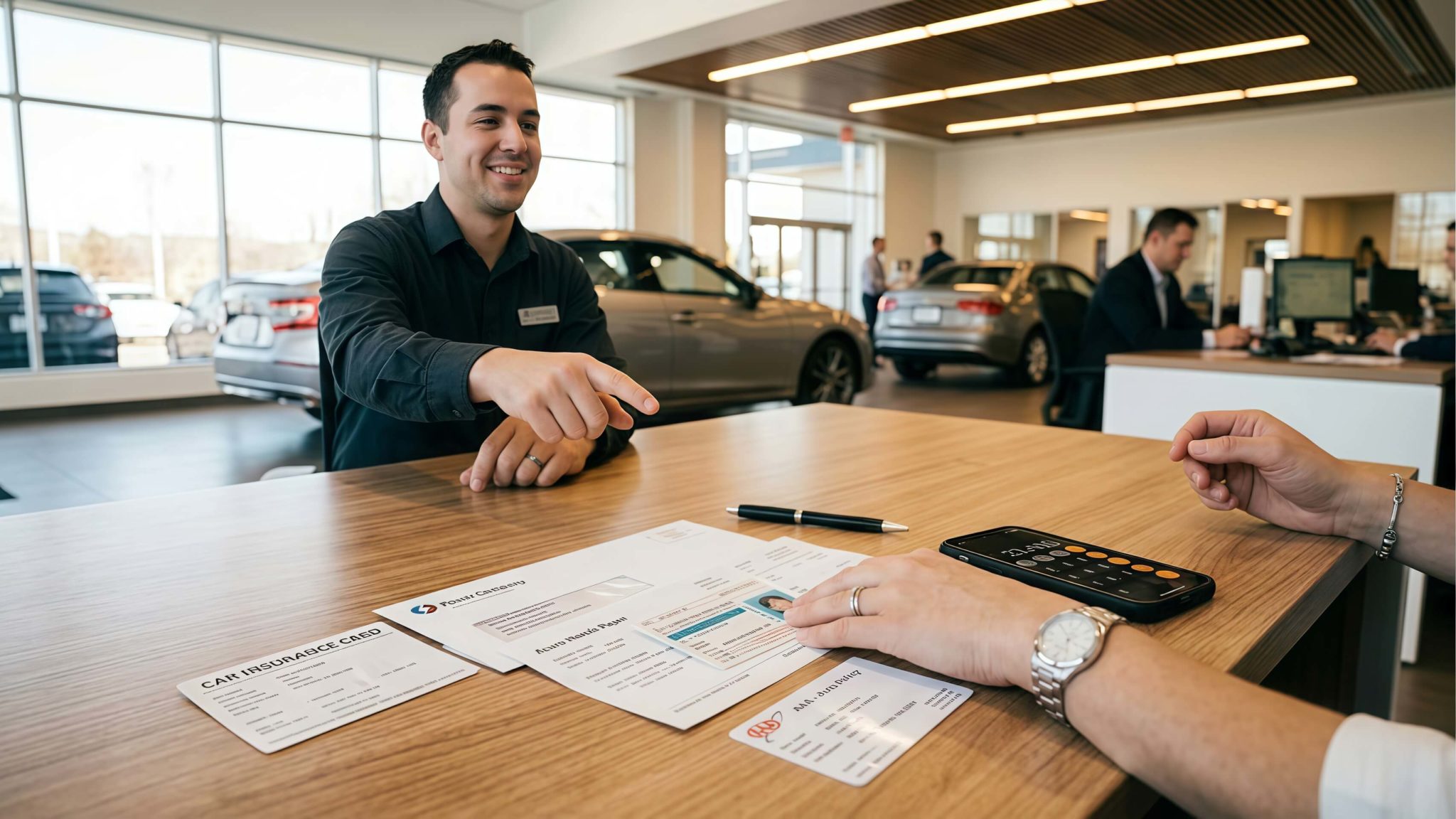
Lenders need to verify who you are, what you earn, and where you live. That’s it. But showing up without the right paperwork is the number-one cause of financing delays.
Get these together before you visit the dealership. If everything is in order, same-day approval and drive-away is common.
Financing Document Checklist
- Valid government-issued photo ID (driver’s license or passport)
- Proof of income (two most recent pay stubs, or tax returns if self-employed)
- Proof of residency (utility bill or bank statement dated within 30 days)
- Social Security number for the credit check
- Proof of full-coverage auto insurance
Military buyers: Stationed at Eglin AFB or Hurlburt Field? Bring your LES (Leave and Earnings Statement) as proof of income, along with your military ID. We work with LES-based income verification all the time.
Questions About Used Car Financing
The interest rate is the percentage you pay to borrow money. The APR (Annual Percentage Rate) includes the interest rate plus any lender fees, giving you a more complete picture of the total cost. When comparing offers, always compare APR to APR.
At minimum, get quotes from two to three lenders. Multiple auto loan inquiries within a 14-day window count as a single inquiry under FICO scoring, so there’s no penalty for shopping around.
Yes. If your credit score improves or rates drop, refinancing can lower your monthly payment and total interest cost. Most lenders allow refinancing after six months of on-time payments.
GAP insurance covers the difference between what you owe and what your car is worth if it’s totaled. Worth considering if your down payment is less than 20% or your loan term exceeds 60 months — both increase negative equity risk.
With complete documentation, same-day approval is common. Bring your ID, proof of income, proof of residency, and insurance info. Military members should bring their LES and military ID.
Ready to Explore Your Financing Options?
Whether you show up with a pre-approval letter or need help finding the right lender, we’ll work with you. No pressure. Just straight answers.
Verified Sources
Related Guides
- Complete Guide to Buying a Used Car in Florida — Inspection, negotiation, paperwork
- Military Auto Financing Guide — PCS, BAH budgeting, deployment tips
- Get a Trade-In Estimate
Important Disclaimer: This guide is for general educational purposes only and does not constitute financial, legal, or professional advice. Interest rates, lender policies, and loan terms change frequently; always verify current rates directly with lenders. Credit score ranges and APR averages cited are based on publicly available data from Experian, the CFPB, and other sources. Vehicle availability, pricing, and features subject to change without notice. Data sources verified: March 2026. Sources include Experian State of the Automotive Finance Market, CFPB, NCUA, FTC, Edmunds, and Kelley Blue Book.